Which Time of the Year is Best to Visit Switzerland – I almost booked Switzerland in August. Everyone told me it was the “safe” choice — warm weather, everything open, long daylight hours. What they didn’t mention was that I’d be sharing the Matterhorn viewpoint with roughly ten thousand other tourists, paying $400 a night for a basic hotel room, and waiting forty-five minutes to board a train I thought I’d reserved.
I went in late September instead, almost by accident. And honestly? It changed the way I travel.
If you’re trying to figure out which time of the year is best to visit Switzerland, this guide is going to give you the real answer — not the generic “spring and fall are nice” filler you find everywhere else. I’m going to break it down month by month, tell you exactly what each season gets right and wrong, and help you pick the trip that actually matches what you want to experience.



Which Time of the Year is Best to Visit Switzerland
| Detail | Info |
|---|---|
| Country | Switzerland |
| Nearest Major Cities | Zurich, Geneva, Bern |
| Official Languages | German, French, Italian, Romansh |
| Currency | Swiss Franc (CHF) — roughly $1.10 USD per CHF |
| Time Zone | CET (UTC+1) / CEST (UTC+2) in summer |
| Visa Requirements | Schengen Visa (US citizens get 90 days visa-free) |
| Best Duration of Stay | 7–12 days |
Why Switzerland Made Me Rethink Everything I Knew About Travel Timing
Switzerland is one of those rare destinations that genuinely works in every season — but for completely different reasons.
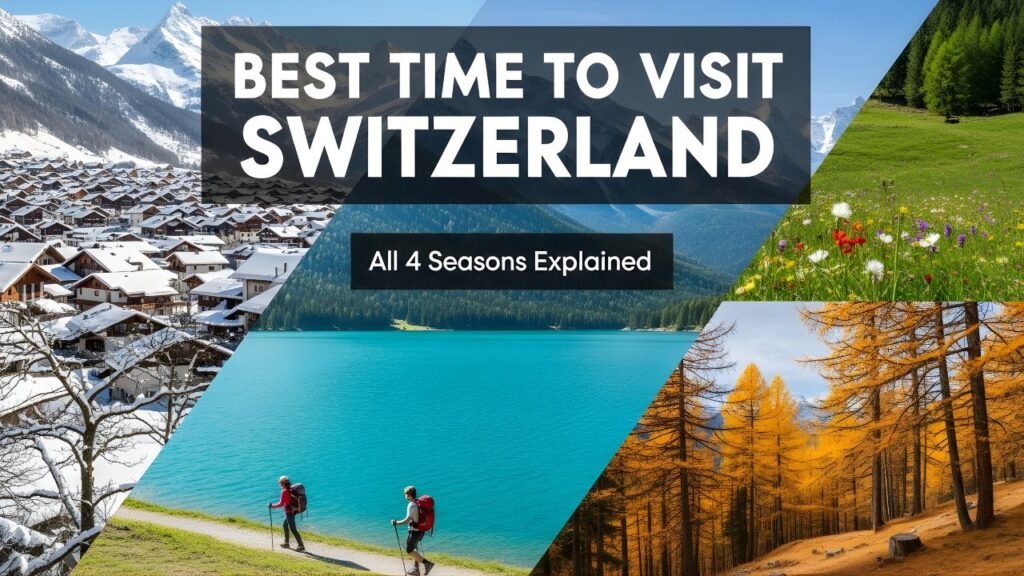
Summer gives you hiking, warm alpine air, and festivals. Winter turns the whole country into a ski resort. Spring brings wildflowers across the valleys and smaller crowds. Fall hands you golden larches, harvest season, and the best photography light of the year.
The trap most American travelers fall into is picking the “peak” season because it feels safer. But peak season in Switzerland means paying a premium on everything — flights, hotels, trains, and even restaurant meals — while fighting crowds at every viewpoint you came to see.
Which time is best to visit Switzerland depends entirely on what you’re after. I’ll break that down for you now.
Switzerland Season-by-Season: The Complete Month-by-Month Travel Table
| Month / Season | Weather | Crowd Level | Best For |
|---|---|---|---|
| January | Cold, heavy snow | Low–Medium | Skiing, fewer tourists, cozy fondue vibes |
| February | Cold, snowy | Medium (ski season peak) | Ski resorts, winter sports |
| March | Cold to mild, patchy snow | Low | Budget travel, quiet towns, late skiing |
| April | Mild, occasional rain | Low | Wildflower valleys, budget hotels, peaceful hikes |
| May | Warm and fresh, some rain | Low–Medium | Best shoulder season, green landscapes |
| June | Warm, mostly clear | Medium–High | Hiking begins, lakes warm up |
| July | Hot in valleys, warm in Alps | Very High | Peak summer, all attractions open |
| August | Hot and crowded | Very High (peak) | Festivals, full access — but expensive |
| September | Mild and golden | Medium | Sweet spot — great weather, smaller crowds |
| October | Cool, vivid fall colors | Low–Medium | Fall foliage, wine harvest, quiet villages |
| November | Cold and grey | Very Low | Off-season prices, fewer options open |
| December | Cold, festive, snowy | Medium–High | Christmas markets, ski season begins |
The Best Time to Visit Switzerland for Each Type of Traveler
This is where it gets interesting. There’s no single best month — there’s a best month for you.
For Hikers and Outdoor Adventurers
June through mid-September is your window, and mid-June to mid-July is the sweet spot within that window.
By late June, the high-altitude trails are clear of snow. The air is crisp, wildflowers are still blooming across the alpine meadows, and the summer crowds haven’t fully hit yet. I did the Haute Route from Chamonix to Zermatt in late June and saw maybe a quarter of the people I expected.
By August, those same trails are packed. You’ll still have a great time, but you’ll be booking mountain huts months in advance and sharing every iconic view with a crowd.
September is the hidden ace card for hikers. The trails are still open, the weather is often more stable than July, and the larches start turning gold — which means the scenery is arguably better than peak summer. This is which time is good to visit Switzerland if hiking matters to you.
For Skiers and Winter Sports Fans
January and February are Switzerland’s ski season crown jewels. Verbier, Zermatt, St. Moritz, and Davos are all fully operational with the best snow conditions of the year.
February is technically the busiest ski month — European school holidays bring families from across the continent. If you want great snow with slightly fewer lift lines, mid-January is often the smartest call.
December is a solid choice too, especially if you want to combine skiing with Christmas market culture. The markets in Zurich, Basel, and Lucerne are genuinely magical — not touristy in a cheesy way, but warm and old-world in a way that makes you want to stay.
For Budget-Conscious Travelers
March, April, and November are your friends here.
March sits in that strange gap between ski season winding down and summer hiking season starting up. Hotels in mountain towns drop their rates by 30–40%. Trains are emptier. You can actually get a table at that lakeside restaurant without a reservation.
April is one of the most underrated months to visit Switzerland. The valleys are green, flowers are blooming in the lower elevations, and you’ll have UNESCO World Heritage sites almost to yourself. Accommodation prices in cities like Lucerne and Interlaken are noticeably lower than they’ll be in July.
The one trade-off with early spring: some high-altitude attractions (cable cars, mountain passes) may still be closed. Always check operating dates before booking.
For Photographers and Scenery Lovers
Two moments stand out above everything else: late September to mid-October for fall foliage, and late December to February for snow-covered alpine villages.
The October light in Switzerland is extraordinary. Golden larches against snow-dusted peaks in the Engadine Valley around St. Moritz is the kind of shot you’ll spend the rest of your life trying to replicate. Early morning fog lifting off Lake Geneva with vineyards in full harvest color — that’s a photo that wins awards.
If you want snow-village charm for photography, head to Grindelwald or Wengen in January before the ski crowds fully descend. Arrive a day before sunrise and you’ll get those pristine, untracked snow scenes that look like they came from a Swiss chocolate box — because they did.
Top 12 Places to Visit in Switzerland (And When to Go to Each)
Switzerland is compact — roughly the size of West Virginia — but it packs more diversity per square mile than almost anywhere I’ve traveled. Here are the places worth your time, with honest timing advice for each.
1. Zurich
Switzerland’s largest city works year-round but shines hardest in December (Christmas markets along the Bahnhofstrasse are spectacular) and late spring when the lake is mirror-calm and the old town cafes spill onto the cobblestones.
2. Interlaken
The adventure capital of Switzerland, wedged between two lakes with the Jungfrau massif as a backdrop. Best from June to September for outdoor activities. Avoid early August unless you’ve booked everything months ahead.
3. Lucerne
The Chapel Bridge, the old town, the lake — Lucerne is gorgeous in every season. May and October give you the best balance of weather, color, and manageable crowds.
4. Zermatt
Home of the Matterhorn, and one of the most car-free, ski-in-ski-out mountain towns in the world. Go in January or February for skiing, or late July to early September for the famous Matterhorn hiking trails. The Gornergrat Railway gives you an eye-level view of the peak that still stops me cold every time I see it.
5. Grindelwald
The gateway to Jungfraujoch — the “Top of Europe” at 11,388 feet. Go in late June through August when the cable cars and mountain railways are all running. Visit the Eiger North Face at sunrise and you’ll understand why mountaineers have obsessed over this peak for over a century.
6. Geneva
The most cosmopolitan city in Switzerland, home to the UN and the famous Jet d’Eau on the lake. Works beautifully in spring and early fall when the lake is at its most photogenic and the city feels alive without being overwhelmed.
7. Bern
Switzerland’s quiet, underrated capital. The medieval arcades (called Lauben) make it pleasant in any weather, which is why November and March — when other cities feel slow — are actually good times to visit Bern. The Einstein Museum here is genuinely fascinating.
8. St. Moritz
This is old-money Switzerland — luxury hotels, frozen lake polo matches, and some of the world’s most reliable ski conditions. January and February are peak season here. September and October bring dramatic fall scenery with almost no crowds.
9. Lugano
Tucked in the Italian-speaking canton of Ticino, Lugano feels like someone transplanted a piece of Lake Como into Switzerland. It’s milder than the rest of the country and works beautifully from April to October, with spring and early fall being the clear winners.
10. Lauterbrunnen Valley
The valley that inspired Tolkien’s Rivendell, with 72 waterfalls cascading down sheer limestone cliffs. Visit in May and June when snowmelt makes the Staubbach Falls and Trümmelbach Falls absolutely thunderous. It’s a level of dramatic that photographs can’t fully capture.
11. Appenzell
This tiny, traditional region in eastern Switzerland barely makes most American itineraries — and that’s exactly why you should go. Folk art, cheese caves, alpine meadows, and almost zero international crowds. Best in late May through June when the cows return to alpine pastures in a traditional procession called the Alpaufzug.
12. The Bernese Oberland
The broader region around Interlaken, Grindelwald, and the Jungfrau is arguably the most scenically intense area in all of Switzerland. July through mid-September is peak season — it’s busy for a reason. But if you can manage late September, you’ll get 80% of the beauty with 50% of the crowds.
Have you already visited one of these spots? Tell me which one surprised you most — I’d genuinely love to hear it in the comments.
Where to Stay, What to Eat, and How to Get Around
Where to Stay
Switzerland is famously expensive, but there are ways to manage it.
- Budget: Youth hostels (Swiss Youth Hostels network is excellent), Airbnb in suburban areas, and guesthouses in smaller towns run $60–$120/night
- Mid-range: Three-star hotels in city centers or mountain villages, $150–$250/night
- Splurge: Four and five-star alpine hotels with views — $350–$700+/night
Book 3–6 months ahead for summer and ski season. Off-season? You can often book a week out and get great deals.
What to Eat
Don’t leave Switzerland without trying:
- Fondue — best in Gruyères, the town the cheese is named after
- Rösti — a crispy Swiss potato dish that’s technically breakfast but nobody’s judging
- Raclette — melted cheese scraped over potatoes and pickles (order this in any mountain town)
- Zürcher Geschnetzeltes — veal in cream sauce over rösti, a Zurich classic
Eating out is pricey. Budget $25–$45 per person for a sit-down lunch, $40–$70 for dinner. Grocery stores (Migros and Coop) sell excellent sandwiches, pastries, and prepared meals for under $10 — this is how I survived multiple Switzerland trips without going broke.
How to Get Around
The Swiss Travel Pass is worth every dollar if you’re covering multiple cities. It covers trains, buses, boats, and many mountain railways. A 8-day pass runs around $400–$500 USD depending on class, but when you factor in how much individual tickets cost, it often pays for itself by day three.
Switzerland’s trains run to the minute — I’ve never had a delayed connection in six visits. The SBB app (Swiss Federal Railways) is essential: download it before you land.
Pro Tips and Mistakes Most Tourists Make
Don’t skip the Swiss Travel Pass math. If you’re only staying in one city, skip it. If you’re doing Zurich + Lucerne + Interlaken + Zermatt, buy it immediately.
Don’t assume mountain attractions are always open. Jungfraujoch, the Schilthorn, and the Titlis all have seasonal closures and weather-dependent cancellations. Check the official websites the night before, not just the morning of.
Don’t drink the tap water — wait, do. Swiss tap water is some of the cleanest in the world. Refill your bottle at any public fountain and skip buying plastic bottles entirely.
Don’t plan every hour of your day. Switzerland rewards wandering. Some of my best memories came from missing a train, stopping at a random village, and stumbling into a local cheese festival nobody had told me about.
Don’t exchange money at the airport. The rates are brutal. Use a Charles Schwab debit card (no foreign transaction fees, ATM fee refunds) or Wise card and withdraw CHF from local ATMs.
Budget Breakdown: What to Actually Expect to Spend
Switzerland has a reputation as the most expensive country in Europe, and that reputation is earned. But it’s manageable if you plan for it.
| Category | Budget Traveler | Mid-Range | Splurge |
|---|---|---|---|
| Accommodation (per night) | $70–$120 | $150–$250 | $350–$700+ |
| Meals (per day) | $30–$50 | $60–$100 | $100–$200+ |
| Transportation | Swiss Travel Pass ~$50/day | Same | Private transfers |
| Activities | $20–$60/day | $60–$120/day | $150+/day |
| Daily Total | $170–$280 | $330–$520 | $600–$1,100+ |
A 10-day Switzerland trip for one person costs roughly $2,500–$4,000 on a mid-range budget all-in, including flights from the US (typically $700–$1,200 round trip depending on city and season).
Cheapest months to travel: March, April, and November consistently offer the lowest accommodation rates and off-peak transportation prices.
How to Plan Your Switzerland Itinerary
Here’s a sample 10-day route that I’d personally recommend for a first-time visitor during the late September sweet spot:
Days 1–2: Zurich
Arrive, recover from jet lag, walk the old town (Altstadt), visit the Kunsthaus, and eat your first rösti. Take the short boat cruise on Lake Zurich at sunset.
Day 3: Lucerne
Forty-five minutes by train. Walk the Chapel Bridge, climb the Musegg Wall, take the cogwheel railway up Mt. Pilatus if skies are clear. Return to Zurich for the night or stay overnight in Lucerne.
Days 4–5: Interlaken + Lauterbrunnen Valley
Two hours from Zurich. Drop your bags in Interlaken and immediately take the train to Lauterbrunnen. Walk up the valley to Staubbach Falls. Next morning, go up to Jungfraujoch (book this day in advance — weather cancellations happen).
Days 6–7: Grindelwald
Take the Eiger Express cable car over the North Face. Hike the First Cliff Walk for a ridge-top perspective that will make your legs shake — in a good way.
Days 8–9: Zermatt
Three-hour journey with a train change in Visp. Check in, walk to the Matterhorn View bridge at dusk, book the Gornergrat Railway for morning. Spend the second day hiking the Five Lakes Walk — five alpine lakes, each reflecting a different angle of the Matterhorn.
Day 10: Geneva or Lausanne
Head west for a final night before flying home. Walk the lakefront promenade in Lausanne and try a glass of Lavaux Chasselas wine — a wine grown on UNESCO-protected terraced vineyards right on the lake. It pairs perfectly with a goodbye.
What does your ideal Switzerland itinerary look like? Drop it in the comments — I’m always curious how people build their routes.
What Is the Rainy Season in Switzerland?
Switzerland doesn’t have a single concentrated rainy season the way tropical countries do. Instead, spring (April–May) and early summer (June) tend to bring the most precipitation in the lowlands and valleys.
The alpine regions can experience afternoon thunderstorms throughout summer, often building up after midday. If you’re hiking, the rule is simple: start early, be at your destination or descending by early afternoon.
November is grey and damp in the cities but can bring beautiful fresh snow to the mountains. It’s a transitional month that works for some travelers and not others.
For the best combination of dry weather and comfortable temperatures, September is consistently the most reliable month across the country.
Which Time of the Year is Best to Visit Switzerland FAQ
Q : Which month is most beautiful in Switzerland?
Ans – September is hard to beat. The summer crowds thin out, temperatures stay comfortable (60s–70s°F in valleys), and the landscape transitions from green to gold. The larches in the Engadine Valley and around Zermatt turn a vivid amber that feels almost unreal in person.
Q : Which is the cheapest month to visit Switzerland?
Ans – November, March, and April consistently offer the lowest prices. November is the off-season low point — some mountain attractions close, but city hotels run 30–40% cheaper than peak summer. March is a close second, especially if ski season is winding down in your target region.
Q : What not to do in Switzerland as a tourist?
Ans – Don’t try to pack too many cities into too few days. Switzerland’s beauty is in slowing down and staying somewhere for two nights instead of one. Also avoid exchanging currency at airports or hotels — the margins are terrible. And please don’t skip the smaller villages: Appenzell, Gruyères, and Murten have more authentic Swiss character than any postcard.
Q : How many days in Switzerland is enough?
Ans – Seven days is the functional minimum for a meaningful trip covering 3–4 regions. Ten to twelve days is the sweet spot — enough time to see the major highlights without feeling rushed, and with room for a day of spontaneous wandering. If you only have 5 days, focus on one region (Bernese Oberland is the best single-region choice).
Q : What is the prettiest city in Switzerland to visit?
Ans – Lucerne wins this debate most consistently, and for good reason — it has the medieval Chapel Bridge, a dramatic lake, snow-capped mountains as a backdrop, and an old town that looks painted. But for pure personality, Lausanne on Lake Geneva gives Lucerne real competition, especially in spring.
Q : Is Switzerland safe for solo female travelers?
Ans – Yes — Switzerland consistently ranks among the safest countries in the world. Public transportation is reliable and well-lit, crime rates are extremely low, and solo travelers (of any gender) move through cities and mountain towns without issue. Standard travel awareness applies, but Switzerland is genuinely one of the most comfortable solo travel destinations anywhere. For updated safety guidance, check the U.S. State Department’s travel advisory before your trip.
Final Thoughts: So, Which Time of Year Is Best to Visit Switzerland?
Here’s the honest version:
- Best overall: September (sweet spot of weather, crowds, and scenery)
- Best for hiking: June–early July or September
- Best for skiing: January–February
- Best for budget travelers: March, April, or November
- Best for first-timers: May or September
- Best for photographers: October (fall colors) or January (snow scenes)
There is no wrong time to visit Switzerland — there are just different Switzerlands depending on when you go. The mistake is thinking peak summer is the only option. The version most Americans never see — the golden October one, the quiet April one, the snow-globe January one — is often the version they remember longest.
For health and vaccination guidance before travel, the CDC Travelers’ Health page for Switzerland has current recommendations.
Book it. Switzerland will not disappoint you, no matter which season you choose — as long as you choose with intention.