Top 10 Places to Visit in the World : I remember standing on the rim of the Grand Canyon at 5:47 AM, the whole world still dark, waiting. Then light cracked across the Colorado River a mile below me, and every travel cliché I’d ever rolled my eyes at suddenly made complete sense. That’s what the top 10 places to visit in the world do to you. They don’t just impress you — they quietly rearrange something inside you.
This isn’t a recycled listicle. I’ve been to every single destination on this list. Some I visited as a wide-eyed 24-year-old with a backpack and $40 a day. Others I returned to a decade later with more money, more time, and completely different eyes. What I’ll share here is what the glossy brochures always skip — the timing tricks, the real costs, the neighborhoods, the moments worth waking up early for, and the mistakes I made so you don’t have to.
✈️ Best Travel Deals
Whether you’re building your top 10 places to visit in the world before you die bucket list, planning a top 10 places to visit in the world with family, or plotting a romantic getaway, this guide will give you everything you need to stop dreaming and start booking.
 34 Expert Caribbean Cruise Tips Every Cruiser Should Know Before You Set Sail
 Eastern vs. Western Caribbean Cruise: Which One Is Actually Right for You?
 Best Anniversary Trips in the USA: 15 Unforgettable Destinations That’ll Make You Fall in Love All Over Again
 Best Islands to Visit in Greece: The Honest American’s Guide to the Aegean
| Quick Facts | Details |
|---|---|
| Article Focus | Top 10 Global Travel Destinations |
| Currency Reference | US Dollars (USD) |
| Best For | All traveler types — solo, couples, families, adventure seekers |
| Visa Note | Varies by destination — check travel.state.gov before booking |
| Health Advisory | Check CDC travel health notices at wwwnc.cdc.gov/travel |
| Ideal Trip Duration | 10–21 days for a multi-destination trip |
| Budget Range | $80–$400/day depending on destination and style |
Why These Destinations Stopped Me Cold — And Will Stop You Too
Here’s the honest truth: I’ve been to 67 countries, and most of them were wonderful. But certain places hit differently. They get under your skin in a way that makes the trip home feel slightly wrong, like you’re leaving behind a version of yourself that finally woke up.
The most beautiful places in the world to visit aren’t always the most Instagrammed. Sometimes they’re a side street in Rome at midnight when the tourists are gone, or a sunrise you had to earn by waking at 4 AM. The places on this list made me feel something — awe, smallness, joy, disorientation — and that’s the bar they all met.
This list was built around three questions:
- Does this place feel irreplaceable — is there nothing else on Earth quite like it?
- Does it reward a traveler who does the work, not just the Instagram pose?
- Would I send my own parents, my college roommate, or my ten-year-old nephew here with confidence?
Every destination below got a yes on all three.
Best Time to Visit — The Seasonal Breakdown
Before we get into the individual destinations, here’s a general planning table for timing your trip to each. Every place has a sweet spot, and getting there in the wrong season can mean missed views, shoulder-to-shoulder crowds, or weather that ruins your plans entirely.
| Month/Season | Best Destinations | Crowd Level | Best For |
|---|---|---|---|
| January – February | Patagonia, Maldives, Machu Picchu | Low–Moderate | Southern Hemisphere summer, beach escapes |
| March – May | Japan, Paris, Tuscany, Santorini | Moderate | Spring blooms, mild weather, pre-peak pricing |
| June – August | Iceland, Amalfi Coast, Banff | High | Long daylight hours, festivals, summer road trips |
| September – October | Safari Africa, Santorini, Japan (fall foliage) | Moderate | Shoulder season — best value, cooler temps |
| November – December | Bali, New Zealand, Southeast Asia | Low | Dry season begins, fewer crowds, affordable flights |
The September–October window is quietly the best time to travel for most destinations. Prices drop, families have gone home after summer, and the light turns golden in a way that makes every photo look professionally shot.
The Top 10 Places to Visit in the World (Honestly Ranked)
These are in order of how strongly they left a mark on me — not by pure popularity. You’ll find some classics and a few that surprise.
1. Kyoto, Japan — The One That Rewires Your Brain
Kyoto is what top 10 places to visit in the world 2026 lists consistently get right. There’s a reason it keeps appearing. Walking through the Arashiyama Bamboo Grove at 6:30 AM before tour buses arrive, with the stalks clicking in the wind and the light filtering in columns between them — it sounds like a cliché and feels like a religious experience.
🏠 Best Hotels & Accommodation
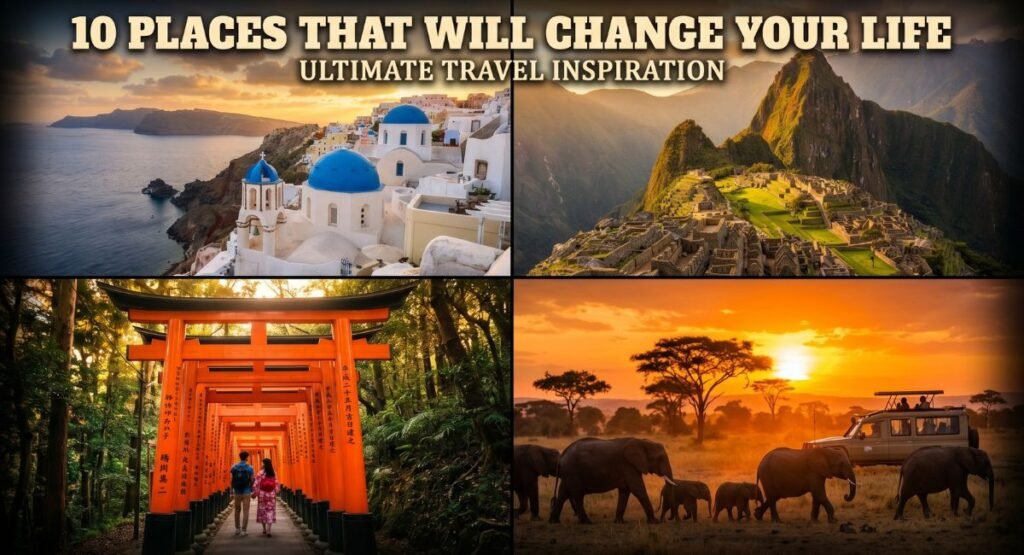
What makes Kyoto irreplaceable: It has over 1,600 Buddhist temples and 400 Shinto shrines, and you could spend three full days just on the eastern Higashiyama District without repeating yourself. The Fushimi Inari Taisha shrine — the one with thousands of orange torii gates climbing a mountain — takes about 2.5 hours to hike top to bottom. Most tourists turn back at the first plateau. Don’t. The upper trails are where you’ll be almost completely alone.
34 Expert Caribbean Cruise Tips Every Cruiser Should Know Before You Set Sail
Eastern vs. Western Caribbean Cruise: Which One Is Actually Right for You?
Best Anniversary Trips in the USA: 15 Unforgettable Destinations That’ll Make You Fall in Love All Over Again
Best Islands to Visit in Greece: The Honest American’s Guide to the Aegean
Where to stay: The Gion district is where geiko and maiko still walk the cobbled streets at dusk. A traditional ryokan (Japanese inn) here runs $150–$350/night and includes a multi-course kaiseki dinner that alone is worth the trip. If budget matters, the Fushimi area has guesthouses from $45–$80/night.
Getting around: The city bus pass ($5.50/day) covers almost everything. The IC card (Suica or ICOCA) is worth loading for trains.
Real cost: Budget travelers: $70–$90/day. Mid-range: $150–$250/day. Luxury: $400+/day.
Don’t miss: The Philosopher’s Path during cherry blossom season (late March to early April). The two-kilometer canal walk lined with hundreds of sakura trees is one of the 7 most beautiful places in the world moments I’ve personally experienced.
2. Patagonia, Argentina & Chile — The Edge of Everything
If Kyoto feels civilized and refined, Patagonia feels like the planet before humans arrived. The Torres del Paine National Park in Chilean Patagonia contains the iconic three granite towers that shoot straight up from the steppe like something from another planet. The W Trek (a 4-5 day hiking route) is one of the top 50 travel destinations in the world experiences that genuinely earns its reputation.
What makes it irreplaceable: The scale is disorienting in the best way. The Grey Glacier calves ice directly into a lake, and you can kayak up to chunks of ancient ice floating past you. The wind here is infamous — gusts up to 100 mph are not unusual. I’ve literally been knocked sideways on a trail. Lean into it, literally.
Best season: November through March (Southern Hemisphere summer). January and February have the most stable weather, though winds are year-round.
Where to stay: Inside the park, EcoCamp Patagonia offers geodesic dome rooms from around $400/night, all-inclusive. Outside the park in Puerto Natales, solid hostels run $15–$25/night and most decent hotels are $80–$130.
For families: The shorter day hikes around Lago Grey and Mirador Las Torres Base are doable for kids 8+. The boat tour on Lago Grey showing the glacier face is perfect for all ages.
Budget reality: Argentina side (El Chaltén, Los Glaciares) is significantly cheaper than Chilean Patagonia. Daily costs: $60–$80 budget, $150–$250 mid-range.
3. Santorini, Greece — Yes, It Really Looks Like That
I spent years dismissing Santorini as overhyped. Then I sat on a terrace in Oia watching the sunset over the caldera and understood why every travel writer eventually runs out of new things to say about it. The white-washed buildings with blue domes, the sheer volcanic cliffs dropping into the sea, the light at golden hour — it’s genuinely one of the most beautiful places in the world to visit, and no amount of Instagram saturation changes the experience of being there.
The secret move: Stay in Firostefani or Imerovigli instead of Oia. You get identical caldera views (often better, since you can see Oia from a distance), at 30–40% lower prices, with a fraction of the crowds. Oia’s famous sunset viewing point has literal traffic jams of tourists with selfie sticks. From Firostefani, you’ll have a terrace almost to yourself.
What to actually do:
✈️ Best Travel Deals
- Hike the 10km trail from Fira to Oia (3–4 hours, free, spectacular)
- Take a day boat tour to the hot springs, volcano, and the Red Beach
- Visit the prehistoric ruins of Akrotiri — a Bronze Age city preserved under volcanic ash, often called the “Greek Pompeii”
- Eat fresh grilled octopus at a taverna in the fishing village of Ammoudi Bay, directly below Oia
Cost reality: Santorini is expensive. A mid-range caldera-view hotel runs $200–$450/night in peak season (July–August). Visit in May or October and the same room costs $100–$200. Daily food and activities budget: $60–$100.
4. Machu Picchu, Peru — The One You Have to Earn
There’s no casual visit to Machu Picchu. You either fly to Cusco, acclimatize for two days at 11,000 feet elevation (trust me, skip this and you’ll spend day one of your visit feeling like you have the worst hangover of your life), then take the train to Aguas Calientes, and hike up — or you hike the entire Inca Trail over four days. Either way, when those ruins finally appear in the mist below Huayna Picchu mountain, the effort makes the moment hit harder than any easy destination ever could.
🏠 Best Hotels & Accommodation
The timing secret: Tickets are now timed and limited. Book at least 3–4 months in advance through the official Peruvian government portal. Entry for Circuit 1 at 6 AM, before tour groups arrive, gives you the site in near-silence. That light, that mist, that quiet — it’s one of the great top 10 places to visit in the world before you die moments on this list.
For couples: Hike up to the Sun Gate (Inti Punku) on the classic Inca Trail for a sunrise view over the entire citadel. You’ll need the 4-day trail permit for this. It books out months in advance.
For families with kids: The train from Ollantaytambo is perfectly comfortable and the ruins themselves have good paths for children. The lower terraces are easiest; Huayna Picchu mountain is steep and not recommended for young kids.
Budget: Machu Picchu entrance is about $47–$58 depending on circuit and time. Inca Trail permit: ~$600–$800 for a guided 4-day trek. Budget accommodation in Cusco: $20–$50/night. Aguas Calientes hotels: $70–$200.
5. Amalfi Coast, Italy — The Most Dramatic Drive on Earth
The SS163 coastal highway hugging the cliffs between Positano and Ravello is not a road so much as a dare. It’s narrow, winding, and frankly terrifying if you’re behind the wheel. Take a bus or a boat instead — and suddenly the terror becomes pure magic. The Amalfi Coast consistently ranks among top 20 countries to visit in the world destination lists because it is, objectively, one of the most visually overwhelming places you can stand.
The real Amalfi move: Avoid staying in Positano (gorgeous but overrun and expensive at $300–$600/night). Stay in Praiano — a smaller hillside village 15 minutes west by ferry — where apartments rent for $120–$180/night and you’ll have the stairs and alleys nearly to yourself in the mornings. Take the ferry into Positano for lunch, photograph it beautifully from the water, and return home before the afternoon chaos.
Don’t miss:
- Ravello’s Villa Rufolo gardens, perched 1,150 feet above the sea
- A lemon granita from a bar in Amalfi town (the lemons here are the size of your head, and the granita costs $3)
- The hike from Bomerano to Positano on the “Path of the Gods” — 4.5 hours, medium difficulty, the single best views on the coast
Budget reality: The Amalfi Coast is expensive. Plan for $200–$350/day mid-range. Visit in May or early October to cut that to $130–$200.
6. Serengeti, Tanzania — Where the World Still Works the Way It Should
There’s a moment on a Serengeti game drive, usually around dawn, when a pride of lions walks within 20 feet of your vehicle and nobody does anything dramatic because this is just how it is here. The animals have no interest in you. You are irrelevant. That moment of irrelevance is somehow one of the most profound feelings I’ve encountered in 25 years of travel.
The Great Migration (July–October in the northern Serengeti, near the Mara River) is one of the most beautiful places in the world spectacles — over a million wildebeest moving across the plains, crossing crocodile-filled rivers in chaotic, thundering masses. If you can only do one African safari in your life, time it for this.
For families: Tanzania is safe and deeply family-friendly. Many lodges offer “Junior Ranger” programs. Kids over 6 are typically welcome on game drives. The Ngorongoro Crater, a two-hour drive from the central Serengeti, has the highest density of predators in Africa and is a shorter driving distance for young travelers.
Where to stay: Budget camping safaris run $150–$250/day all-inclusive (transport, meals, guide, park fees). Mid-range tented camps: $300–$500/person/night. Luxury lodges like Four Seasons Serengeti: $1,000+/person/night.
Logistics: Fly into Kilimanjaro International Airport (JRO) or Julius Nyerere in Dar es Salaam. Domestic flights to Serengeti airstrips exist from Arusha (45 minutes). Road access from Arusha is 7–8 hours. Most travelers combine Serengeti with Ngorongoro Crater and/or Zanzibar for a 10–14 day itinerary.
7. Bali, Indonesia — The Island That Refuses to Disappoint
Every few years, someone declares that Bali is “ruined” by tourism. Every few years, I go back and find that the rice terraces of Tegallalang still glow at golden hour, the temple at Tanah Lot still sits on its rock surrounded by sea, and the food at a $2 warung in Ubud still tastes better than anything I’ve eaten at a $60 restaurant back home.
Yes, Seminyak and Kuta are loud and over-developed. That’s why you spend your time in Ubud (the cultural heart, in the volcanic highlands), Sidemen (a quiet rice valley that Bali must have looked like 30 years ago), or the less-developed Bukit Peninsula in the south, where white-sand cove beaches like Padang Padang and Bingin are still breathtaking.
For couples: Bali is legitimately one of the top 10 places to visit in the world for couples. Private pool villas in Ubud rent for $80–$150/night. A sunset dinner at Swept Away in the COMO Shambhala grounds or a couples’ sunrise hike up Mount Batur (4 AM start, 2-hour climb, jaw-dropping sunrise above the clouds) are genuinely special.
Budget reality: Bali is incredibly affordable for Americans. Daily budget: $40–$60 for backpackers. Mid-range: $100–$180/day. Luxury with villa and spa: $250–$400/day.
Visa: US citizens get a 30-day visa on arrival (free). Extendable for another 30 days in Denpasar for a small fee.
✈️ Best Travel Deals
8. Iceland — The Planet in Its Rawest Form
Iceland doesn’t care that you’re there. Geysers erupt on their own schedule. Glaciers calve when they feel like it. The Northern Lights appear or they don’t, and no amount of wishing changes that. There’s something deeply refreshing about traveling somewhere that operates entirely on its own terms.
The Ring Road (Route 1) — a 828-mile highway circling the entire island — is the best road trip I’ve ever taken. Twelve to fourteen days, renting a 4WD campervan, and you’ll see waterfalls you can walk behind (Seljalandsfoss), black sand beaches with enormous basalt columns (Reynisfjara, but be warned: sneaker waves here are genuinely dangerous — stay back), the Jökulsárlón glacial lagoon where icebergs float out to sea, and the colorful fishing village of Ísafjörður in the Westfjords that barely any tourists reach.
Northern Lights: Visible September through March in areas with low light pollution. Vík, the Snæfellsnes Peninsula, and the Westfjords are ideal. You need clear skies and a KP index of 3 or higher (check vedur.is for forecasts). Don’t book an expensive “Northern Lights tour” — just drive 15 minutes outside Reykjavík on a clear night and look up.
Budget: Iceland is expensive. Campervans: $120–$200/day rental. Accommodation in guesthouses: $120–$220/night. Food is the biggest shock — a basic restaurant meal runs $25–$40. Cooking in a campervan saves serious money.
9. Marrakech, Morocco — Controlled Chaos and Absolute Beauty
Stepping through the gate of the Djemaa el-Fna square in Marrakech for the first time feels like stepping into a film set where someone turned everything up to 11. Snake charmers, Gnawa musicians, orange juice vendors, smoke from a dozen food stalls — it is overwhelming, colorful, and impossible to look away from. And that’s just the main square.
The medina (the old walled city) is a true maze of souks, riads, hammams, and hidden courtyards. Get lost in it. The dye pits at the Chouara tannery in Fez (a 3-hour drive north) are one of the most beautiful places in the world in a purely visual, purely ancient sense — colors unchanged since the 11th century.
For families: Marrakech is very family-friendly. Kids are welcome everywhere. The Majorelle Garden (once owned by Yves Saint Laurent) and the new Bab el Khamis flea market are perfect for all ages. The cooking class culture here is fantastic — half-day classes at Souk Cuisine run about $65/person including a market tour.
Where to stay: A riad (a traditional Moroccan home with an interior garden) in the medina. Budget riads: $50–$90/night. Mid-range: $100–$180/night. Luxury (Riad Farnatchi, La Mamounia): $300–$1,500+/night.
Safety: Morocco is generally very safe for tourists. Women traveling solo should expect some attention in the souks but firm, confident navigation handles most of it. The US State Department currently rates Morocco at Level 1: Exercise Normal Precautions.
10. New Zealand’s South Island — The Lord of the Rings Was Understating It
I’ve driven through Fiordland National Park in the rain, and it was still one of the most beautiful natural scenery experiences of my life. Milford Sound — the fiord carved by glaciers, flanked by walls of rock dropping 4,000 feet straight into dark water, with waterfalls appearing after every rainstorm — makes you feel like the planet is showing off.
The South Island concentrates New Zealand’s greatest hits: Queenstown (adventure capital of the world — bungee jumping was invented here), the Mirror Lakes near Te Anau, the turquoise-blue rivers of the Canterbury Plains, the Abel Tasman coastal track, and the Aoraki/Mount Cook National Park.
For adventure travelers: The Milford Track (4-day guided hike, $1,200–$1,800 all-inclusive) is one of the most famous walks in the world. Queenstown offers bungy jumping from $140, skydiving from $250, white-water rafting from $90, and helicopter skiing in winter.
For families: Kaikōura on the east coast offers whale-watching tours ($100–$160/adult, $60/child) where you’re nearly guaranteed to see sperm whales, dolphins, and seals. The Moeraki Boulders on the Otago Coast — giant spherical rocks on a beach that look like they were placed by aliens — are a genuinely weird and wonderful stop.
Budget: New Zealand is mid-range to expensive. Campervan rental: $90–$160/day. Hostels: $25–$45/night. Mid-range hotels: $130–$250. Daily spend (excluding accommodation): $60–$100.
Where to Stay, Eat, and Get Around — The Practical Breakdown
Here’s the honest framework I use for every trip, adapted for these destinations.
Accommodation Strategy
Book the anchor nights, leave the rest flexible. Your first and last nights should always be pre-booked near the airport. For everything in between, I generally book 2–3 days ahead, especially outside peak season. This gives you flexibility without the anxiety of showing up somewhere without a room.
- For Kyoto and Bali: Book ryokans and villas 3–4 months ahead for peak season (cherry blossom in Japan, July–August in Bali)
- For Patagonia: The in-park lodges (EcoCamp, Las Torres) book out 6–12 months ahead during peak season
- For Santorini: Caldera-view properties for July–August book out by January. Book in September for next summer
Getting Around
- Japan: The JR Pass ($275–$575 depending on duration) pays for itself quickly if you’re traveling between cities. In Kyoto, bus day passes are $5.50.
- Amalfi Coast: Ferries are faster, more scenic, and less stressful than driving. The SITA bus passes are $3–$5/ride.
- Patagonia: Rent a car in Puerto Natales or Punta Arenas. 4WD is worth the upgrade.
- Tanzania: Pre-booked safari vehicle with guide is essentially mandatory. No DIY driving in the Serengeti.
- Morocco: Within Marrakech, walk the medina. For day trips to the Atlas Mountains or the desert, hire a driver ($60–$100/day) rather than navigating yourself.
Food Philosophy
At every destination on this list, the best food is the cheapest food. In Japan, the $8 ramen shop with a line out the door. In Morocco, the $2 pastilla at a market stall. In Peru, the $3 fresh ceviche at a Cusco market lunch spot. I’ve spent $150 on dinners that didn’t move me. I’ve spent $6 on meals I still dream about.
“I almost missed the best meal of my entire trip to Japan because it was in a basement with no English sign and I almost walked past it. The plastic food model in the window was the only clue. Best tonkotsu ramen I’ve ever had. $9.50. Three people were crying while eating it — including me.”
Pro Tips and Common Tourist Mistakes to Avoid
These are the patterns I see over and over again. Avoid them and your trip immediately becomes 40% better.
Mistake 1: Front-loading every activity Don’t try to see everything on day one. You’ll be jet-lagged, overwhelmed, and your photos will be frantic. Give yourself a slow, exploratory first afternoon wherever you land.
Mistake 2: Only visiting the “main” site In Kyoto, everyone goes to Fushimi Inari. Almost nobody walks five minutes further into the Tofuku-ji temple grounds next door, which is equally stunning and nearly empty. Every destination on this list has an adjacent, overlooked gem. Ask locally, ask your hotel, ask at the tourism office.
Mistake 3: Ignoring altitude Machu Picchu, Cusco, and Patagonia (less so, but the trekking is intense) all require acclimatization. Arriving in Cusco and heading straight to the ruins is a recipe for altitude sickness. Spend 2 nights at elevation first. Drink coca tea. Move slowly. Your itinerary will thank you.
Mistake 4: Booking the wrong season to “save money” Peak season exists because conditions are best. In Patagonia, budget travel in May to save money means you may face snow, closed trails, and park shutdowns. In Morocco, July in the Sahara Desert tours means 115°F heat. Shoulder season (just before or after peak) is the sweet spot — 20–30% cheaper with 80% of the experience.
Mistake 5: Not having travel insurance This sounds boring until you twist your ankle on a Machu Picchu trail and need a medical evacuation from Peru. Travel insurance for a two-week international trip costs $60–$150 through providers like World Nomads or Allianz. Do not skip this.
What’s the one mistake that cost you the most on an international trip? Drop it in the comments — it might save the next reader from the same headache.
Budget Breakdown — What You’ll Actually Spend
The honest numbers. These are real daily spend estimates in USD per person, based on my actual spending and data from 2024–2026.
| Destination | Budget/Day | Mid-Range/Day | Luxury/Day | Best Value Window |
|---|---|---|---|---|
| Kyoto, Japan | $70–$90 | $150–$250 | $400+ | Nov & early March |
| Patagonia | $60–$80 | $150–$250 | $500+ | Nov & late Feb |
| Santorini, Greece | $100–$130 | $200–$350 | $600+ | May & October |
| Machu Picchu, Peru | $50–$70 | $120–$200 | $350+ | May & September |
| Amalfi Coast, Italy | $120–$160 | $200–$350 | $500+ | May & October |
| Serengeti, Tanzania | $200–$250* | $350–$500* | $800+* | May–June (low season) |
| Bali, Indonesia | $40–$60 | $100–$180 | $300+ | April–June, Sept |
| Iceland | $130–$160 | $220–$320 | $500+ | Sept & May |
| Marrakech, Morocco | $50–$70 | $110–$180 | $350+ | March–May, Oct–Nov |
| New Zealand South Island | $90–$120 | $180–$280 | $450+ | March–May |
*Tanzania figures are all-inclusive (accommodation, meals, guide, vehicle, park fees) — not comparable to other destinations where accommodation is listed separately.
Flight costs from the US (approximate round-trip, economy):
- Japan: $650–$1,100 from West Coast; $900–$1,400 from East Coast
- Patagonia: $700–$1,200 depending on season
- Greece/Italy: $500–$900 with a connection in Europe
- Tanzania: $900–$1,400 with a connection in Europe or Middle East
- Bali: $700–$1,100 from West Coast
- Iceland: $400–$700 (great direct routes from NYC, Boston, Denver, DC)
- Morocco: $500–$850 via European hub
- New Zealand: $900–$1,400 from West Coast, more from East Coast
- Peru: $450–$750
How to Plan Your Itinerary — Day-by-Day Suggestions
For most American travelers, the sweet spot is a 10–14 day international trip. Here are two proven itinerary frameworks.
10-Day Framework: Japan Focus
- Day 1–2: Arrive Tokyo. Jet lag recovery, Shinjuku, Tsukiji Outer Market breakfast
- Day 3–4: Bullet train to Kyoto (2h 20min). Fushimi Inari at dawn, Gion at dusk
- Day 5: Arashiyama bamboo grove, Kinkaku-ji (Golden Pavilion), Philosopher’s Path
- Day 6: Day trip to Nara (deer park, Todai-ji temple) — 45 minutes by train
- Day 7: Hiroshima and Miyajima Island — full-day trip. The Peace Memorial is one of the most important hours you’ll spend anywhere
- Day 8–9: Return to Tokyo. Shibuya, Harajuku, teamLab Borderless digital art museum
- Day 10: Depart from Tokyo Narita or Haneda
14-Day Framework: Europe’s Greatest Hits
- Day 1–2: Arrive Rome. Colosseum, Vatican, Trastevere neighborhood
- Day 3–4: Train to Naples (1h 10min). Day trip to Pompeii and Herculaneum
- Day 5–7: Amalfi Coast — base in Praiano. Ferry to Positano, Path of the Gods hike, Ravello
- Day 8–9: Train north to Florence. Uffizi Gallery, Ponte Vecchio, day trip to Siena
- Day 10–11: Flight to Santorini. Sunset in Firostefani, Akrotiri ruins, boat tour
- Day 12–13: Athens. Acropolis at sunrise (skip midday heat), Plaka neighborhood
- Day 14: Depart from Athens
FAQ — What People Actually Ask Before Booking
Final Word — Stop Planning, Start Going
The single biggest mistake I see among American travelers is spending more time researching than actually going. The perfect trip doesn’t exist. Something will go wrong — a flight delay, a rainstorm at the wrong moment, a stomach situation somewhere between Marrakech and the airport. That’s travel. That’s what makes the stories.
The top 10 places to visit in the world are not perfect. They’re overwhelming, exhausting, occasionally over-touristy, and logistically challenging. They’re also the reason I keep coming back to the airport, bag in hand, passport stamped, heart a little larger than the last time I left.
Book the ticket. Figure out the rest.
Planning your trip? Explore more destination guides at World Fusion Tours — we cover everything from off-the-beaten-path adventures to luxury itineraries for every kind of traveler.
For US government travel advisories and safety information: travel.state.gov For health and vaccination requirements: wwwnc.cdc.gov/travel
Have you been to any of these destinations? Which one surprised you most — for better or worse? Tell me in the comments. Genuinely curious what your experience was like.