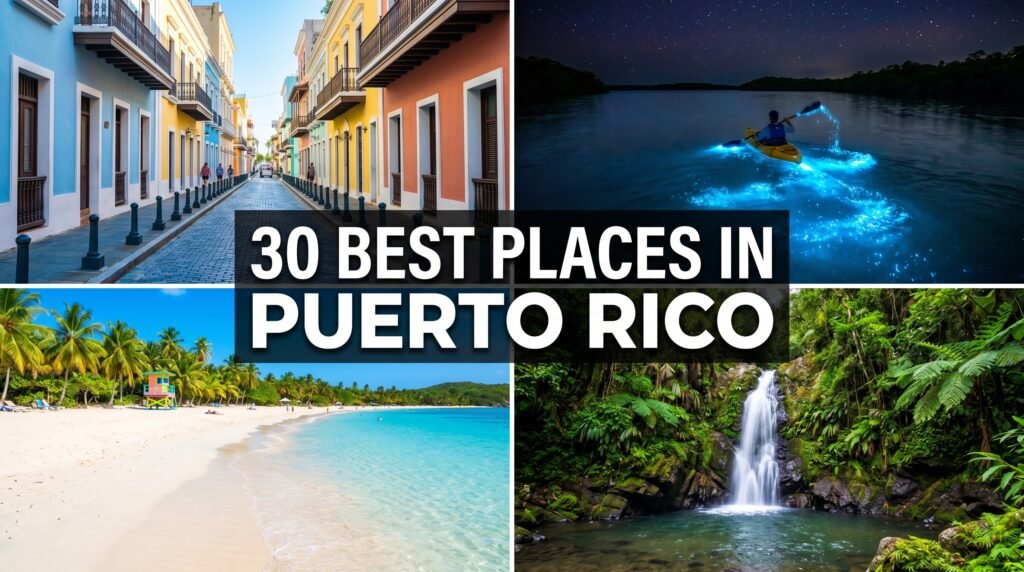
30 Incredible Places to Visit in Puerto Rico : I didn’t plan on staying three extra days in Puerto Rico. I booked a week, packed for warm weather, and figured I’d knock out the main sights and head home. That didn’t happen. Somewhere between wandering the cobblestone streets of Old San Juan at golden hour and watching bioluminescent water glitter around my kayak paddle in Mosquito Bay, I quietly moved my flight.
Puerto Rico isn’t just a Caribbean island — it’s the closest thing to a full-blown international adventure that U.S. passport holders can have without customs lines or currency exchanges. And yet most visitors barely scratch the surface of what this island holds.
This guide covers 30 incredible places to visit in Puerto Rico, including the spots every travel blog covers and the hidden gems most tourists walk right past. Whether you’re planning where to visit in Puerto Rico for the first time or you’ve been before and want something new, this is the resource I wish I’d had before I landed.
 34 Expert Caribbean Cruise Tips Every Cruiser Should Know Before You Set Sail
 Eastern vs. Western Caribbean Cruise: Which One Is Actually Right for You?
 Best Anniversary Trips in the USA: 15 Unforgettable Destinations That’ll Make You Fall in Love All Over Again
 Top 10 Places to Visit in the World That Will Ruin Every Other Trip (In the Best Way)
Quick Facts: Puerto Rico at a Glance
Why Puerto Rico Stopped Me in My Tracks
Most people think Puerto Rico equals San Juan. They fly in, spend all their time in the Condado hotel strip, see El Morro, and fly home thinking they’ve seen it. They haven’t.
The island is staggeringly diverse for its size. Within two hours of Old San Juan, you can be standing in the middle of a tropical rainforest, floating in glowing water, hiking to a mountain peak with views in every direction, or surfing world-class breaks on the west coast. There are cave systems, coffee farms, 270-degree ocean lookouts, and beach towns that feel completely frozen in time.
Puerto Rico also offers something no other Caribbean destination can for Americans — you never feel like a foreigner. Dollar bills work everywhere. Your cell plan works. Medical care is solid. The roads are navigable. But the culture, food, music, and landscape? Completely distinct and deeply Puerto Rican.
I’ve traveled to over 40 countries and spent real time on a dozen Caribbean islands. Puerto Rico belongs in a conversation with the most beautiful places I’ve ever been — and it’s significantly underrated.
Best Time to Visit Puerto Rico
Timing your trip right changes everything. Puerto Rico is a year-round destination, but each season has a real personality.
| Month / Season | Weather | Crowd Level | Best For |
|---|---|---|---|
| December – April | 75–85°F, low humidity, minimal rain | HIGH (peak season) | Beach weather, festivals, comfortable sightseeing |
| May – June | Warming up, occasional afternoon showers | MODERATE | Fewer crowds, good deals, lush green scenery |
| July – August | Hot and humid, 85–90°F, brief rain bursts | MODERATE-HIGH | Families (school break), surf on north coast |
| September – October | Hurricane season peak, heaviest rainfall | LOW | Budget travel, surfers on west coast, solitude |
| November | Cooling down, less rain, pre-peak calm | LOW-MODERATE | Best value window before holiday crowds |
My honest recommendation: Visit in late November or early May. You get near-perfect weather, dramatically lower hotel rates than December through March, and you won’t be fighting cruise ship crowds at every attraction.
The December through March window is genuinely beautiful but prices spike hard, especially around the holidays when San Juan hotels can run $300–$500/night for midrange rooms.
Have you visited Puerto Rico during hurricane season? I’d genuinely love to hear how the trip went — share your experience in the comments.
30 Incredible Places to Visit in Puerto Rico
Old San Juan (Viejo San Juan)
If you only have one day on the island, spend it here. Old San Juan is one of the most atmospheric colonial cities in the entire Western Hemisphere — and it’s not hyperbole.
34 Expert Caribbean Cruise Tips Every Cruiser Should Know Before You Set Sail
Eastern vs. Western Caribbean Cruise: Which One Is Actually Right for You?
Best Anniversary Trips in the USA: 15 Unforgettable Destinations That’ll Make You Fall in Love All Over Again
Top 10 Places to Visit in the World That Will Ruin Every Other Trip (In the Best Way)
The neighborhood sits on a small islet connected to the main island, walled on three sides, and painted in colors that seem almost too saturated to be real. Ochre yellows, dusty blues, terracotta reds — the whole city looks like someone turned up the saturation dial.
Walk the full perimeter wall along Paseo del Morro in the late afternoon. The views of the Atlantic crashing against 500-year-old fortifications, with the lighthouse of El Morro in the background, is one of those sights that stops conversation completely.
Castillo San Felipe del Morro (El Morro)
This is the most photographed place in Puerto Rico and the recognition is earned. The six-level fortress juts out into the ocean, and the grass fields between it and the city wall are perfect for flying a kite (locals do this constantly) or simply lying down and staring at the sky.
Get here when it opens at 9 AM. By 11 AM the cruise ship passengers arrive and the magic drops significantly.
Castillo San Cristóbal
Larger than El Morro, San Cristóbal gets fewer visitors because it sits inland rather than on the dramatic peninsula. That’s your advantage. The tunnels, dungeons, and barracks here are more extensive and the crowds are thinner. Budget two hours minimum.
Admission: $10 for adults covers both forts — one of the best value experiences in all of Puerto Rico.
Calle del Cristo and La Fortaleza Street
Don’t just walk the main tourist drag of Calle Fortaleza. Dip down Calle del Cristo toward the tiny Capilla de Cristo chapel at the southern tip of the wall — the story behind why it was built involves a rider who couldn’t stop his horse at the cliff’s edge, and the chapel was either built in gratitude for his survival or his death depending on which version you hear.
The blue cobblestones throughout Old San Juan, by the way, aren’t decorative — they’re ballast stones brought over from Spain on ships. Walking on them is literally walking on history.
El Yunque National Forest
The only tropical rainforest in the entire U.S. National Forest System sits 45 minutes east of San Juan, and it is legitimately spectacular.
El Yunque receives around 100 billion gallons of rain annually. The result is a lush, misty, layered jungle that feels almost prehistoric. Tree ferns tower 20 feet overhead. The rare Puerto Rican parrot (one of the world’s most endangered birds) lives here. Coquí frogs call from every direction at dusk.
La Mina Falls
The most popular hike leads to La Mina Falls, a 35-foot cascade with a swimming pool at the base. The trail is well-marked and doable for most fitness levels — about 2.5 miles round trip. Go before 10 AM or after 2 PM to avoid the heaviest crowds.
El Toro Trail
For something more serious, the El Toro Trail climbs to the highest peak in El Yunque at 3,533 feet. The views from the top, when the clouds aren’t socked in, stretch across the entire eastern part of the island. Bring real hiking shoes — it gets muddy fast.
Bioluminescent Bay, Vieques (Mosquito Bay)
Mosquito Bay on Vieques Island holds the Guinness World Record for the brightest bioluminescent bay on Earth. I’ve kayaked bioluminescent bays in four countries. Nothing compares to this.
The phenomenon comes from dinoflagellates — microscopic organisms that emit a blue-green light when disturbed. In Mosquito Bay, the concentration is so high that every paddle stroke, every splash, every fish darting beneath the surface lights up like a living neon sign.
You need to take a guided kayak tour — swimming is prohibited to protect the bay. Tours run $45–$65 per person and depart from Esperanza on Vieques.
Getting to Vieques: Take the ferry from Ceiba (about 30 minutes, ~$2 each way) or fly from San Juan (20 minutes, ~$80–$150 round trip). Book the ferry well in advance — it fills up.
Do not take a motorized boat tour. The propellers damage the organisms and reduce the glow. Paddle or electric boat only.
Flamenco Beach, Culebra
Consistently ranked among the most beautiful beaches in the Caribbean, Flamenco Beach is a horseshoe-shaped bay on the small island of Culebra with water so clear you feel like you’re swimming in glass.
The sand is fine, white, and powder-soft. The water is calm inside the horseshoe. Snorkeling off the rocks at either end reveals an impressive reef system.
Getting there: Ferry from Ceiba (~$2.25 each way) or small plane from San Juan (~$80–$120). The island itself has golf carts and bikes available to rent — it’s small enough to explore in a day, though spending a night at one of the guesthouses transforms the experience entirely.
Culebra also has Zoni Beach (more secluded, rougher, dramatic rocky backdrop) and Carlos Rosario Beach (excellent snorkeling, often empty).
Luquillo Beach (Balneario La Monserrate)
The easiest gorgeous beach accessible from San Juan — Luquillo Beach is about 35 minutes east of the city and a world away from the hotel-lined Condado strip.
The beach stretches in a long crescent backed by coconut palms. The water is warm, relatively calm, and an impossible shade of turquoise. On weekday mornings it’s blissfully quiet.
Kiosk Row at the entrance sells some of the best beach food I’ve found anywhere in Puerto Rico — alcapurrias (fried yuca fritters stuffed with meat), bacalaítos (salted cod fritters), fresh coconut water, and cold Medalla beer. Budget $10–$15 for a solid beachside lunch spread.
Ponce Historic Downtown
Puerto Rico’s second-largest city gets criminally overlooked by visitors who stay glued to San Juan. Ponce has a completely different personality — more colonial European, stately, and architecturally rich.
The Parque de Bombas (the old firehouse) is an absurdly photogenic red-and-black Victorian-era building in the center of Plaza Las Delicias. It’s been a firehouse, a cultural center, and now a small museum. It photographs beautifully at any time of day.
Museo de Arte de Ponce houses one of the finest art collections in all of Latin America — works by Velázquez, Rubens, Rossetti, and Leighton. Admission is around $6 for adults. It’s genuinely world-class and almost always uncrowded.
The Ponce Carnival in late February is one of the wildest and most colorful festivals in the Caribbean — if your timing lines up, don’t miss it.
Camuy River Cave Park (Parque Nacional de las Cavernas del Río Camuy)
The Camuy Caves contain the third-largest underground river system in the world. The cave network extends for miles, and the main accessible portion includes chambers tall enough to fit a 17-story building inside them.
The scale here is hard to process until you’re standing in it. The main Clara Cave opens into an amphitheater-like space with stalactites hanging like frozen chandeliers above the river rushing through the floor.
Tours run every 45 minutes and last about 45 minutes total. The site does get backed up during peak weekends — arrive right when they open at 8:30 AM. Admission is $15 for adults.
Rincón
The surf capital of the Caribbean sits on Puerto Rico’s remote northwest tip, and it has a completely different energy than anywhere else on the island.
Rincón became famous when the World Surfing Championships were held here in 1968. The breaks along the coast — particularly Tres Palmas, Domes, and Sandy Beach — still attract serious surfers from around the world, especially from November through March when Atlantic swells push in.
But Rincón isn’t only for surfers. The sunsets here are genuinely legendary. The town has developed a laid-back expat and foodie scene with excellent restaurants tucked between surf shops and yoga studios.
Whale watching: From January through March, humpback whales pass through the Mona Passage just offshore. Tour operators in Rincón run watching excursions for around $75–$100 per person.
Phosphorescent Bay, La Parguera (Lajas)
For those who can’t make it to Vieques, La Parguera’s Phosphorescent Bay offers a more accessible (though less intense) bioluminescent experience on the southwest coast.
The bay is accessible by motorized boat here (unlike Vieques), which means it’s slightly less pristine but significantly easier to reach from San Juan. Tours run nightly for around $10–$15 — remarkable value.
The village of La Parguera itself is charming: a small fishing community on stilts over the water, with wooden walkways, seafood shacks, and almost zero tourist infrastructure. Exactly the kind of place worth an overnight stop.
Toro Verde Nature Adventure Park
If you want to take a break from beaches and history, Toro Verde in Orocovis sits in the center of the island’s mountainous interior and runs the “The Beast” — once the longest zip line in the world at 1.6 kilometers (it’s been surpassed since, but it remains extraordinary).
The full course includes multiple lines, a Tarzan swing, and rappel stations through the mountain canopy. Prices start around $95 for partial packages and go up to $165+ for the full experience.
The drive through the central mountain region to get here is itself worth the trip — La Ruta Panorámica (Route 143) winds through coffee country with views that routinely stop traffic.
Caguana Indigenous Ceremonial Center
One of the most underrated and historically profound places to visit in Puerto Rico is the Caguana Ceremonial Ball Courts in Utuado.
This 1,000-year-old site was used by the Taíno people — the island’s original inhabitants — for ceremonial ball games and religious rituals. The monolithic stones surrounding the courts are carved with petroglyphs, some of the finest examples anywhere in the Caribbean.
No crowds, no noise, just ancient stone in a mountain valley that feels genuinely sacred. Admission is minimal. It’s one of the most moving places I visited on the entire island.
Cabo Rojo National Wildlife Refuge and Los Morrillos Lighthouse
The Cabo Rojo Lighthouse (Faro Los Morrillos) stands at Puerto Rico’s southwestern tip on cliffs of blushing-red rock above impossibly blue water. The name “Cabo Rojo” (Red Cape) comes from the rust-colored cliffs — and when you see them, you’ll understand why immediately.
The lighthouse dates to 1882. The salt flats surrounding it are a protected wildlife refuge home to hundreds of migratory bird species. In the right light at sunset, the flat water of the salt flats mirrors the sky in a way that photographers chase from across the world.
The beach at the base of the cliffs — Playa Sucia (despite the name, it’s far from dirty) — has some of the most dramatic coastal scenery I’ve ever seen. Bring water; there are no services here.
Arecibo Observatory Area
While the famous Arecibo Observatory dish (the world’s largest for decades) collapsed in 2020, the site and surrounding area remain worthwhile to visit. The visitor center remains open and the story of the observatory — including its role in the search for extraterrestrial intelligence — is genuinely fascinating.
The nearby Arecibo Lighthouse and Historical Park is a family-friendly attraction with ocean views, a small aquarium, and replica Columbus ships. It’s a good half-day stop when combined with the Camuy Caves nearby.
Hacienda Buena Vista (Ponce Region)
A beautifully restored 19th-century coffee and corn plantation run by Puerto Rico’s Conservation Trust, Hacienda Buena Vista near Ponce is one of the most educational and atmospheric experiences on the island.
The hacienda operates a working water-powered mill system — the original hydraulic machinery still runs, demonstrating exactly how coffee was processed over 150 years ago. Tours are reservation-only and run on weekends. Admission is around $12 for adults.
Coffee grown here is still processed and sold — I bought a bag and it’s genuinely excellent.
Bosque Estatal de Guánica (Guánica Dry Forest)
Completely opposite to El Yunque in every way, the Guánica Dry Forest on the southwest coast is a UNESCO World Biosphere Reserve and one of the best-preserved subtropical dry forests in the world.
The landscape looks almost alien compared to the rest of Puerto Rico — twisted, skeletal trees, cacti, and rocky trails rather than lush tropical green. The birding here is extraordinary; this forest has more bird species than El Yunque despite its drier character.
Several trails lead down to isolated coves with turquoise water and zero development. Playa Jaboncillo and Playa San Jacinto are accessible on foot through the forest and among the most beautiful hidden beaches I found on the island.
Isla Mona (Mona Island)
If you want the absolute edge of civilization in Puerto Rico, Isla Mona is it. Located 50 miles west of Rincón in the Mona Passage, the island is often called the “Galápagos of the Caribbean.”
Mona is home to giant iguanas, sea turtles that nest on its beaches, massive limestone cave systems, and waters packed with marine life that have never been heavily fished. There are no hotels, no restaurants, no paved roads.
Access is strictly regulated through the Puerto Rico Department of Natural Resources — you need a permit ($1/night camping), and you travel there by private charter from Rincón (~$130–$200 per person round trip). Trips typically run 2–3 days.
This is for serious adventurers only. And it’s absolutely worth it.
Playa Crashboat (Aguadilla)
Near the former Ramey Air Force Base in Aguadilla, Crashboat Beach is a local favorite that tourists routinely miss. The name comes from the crash rescue boats that were once kept here for the Air Force base operations.
The water is clear, calm inside the small bay, and incredibly colorful — shades shifting from pale turquoise to deep blue. The old pier extending into the water makes for spectacular jump-off and photography spots.
The food truck row at the entrance serves excellent local food — try the chillo frito (whole fried red snapper) if you see it available.
Balneario Seven Seas (Las Croabas, Fajardo)
Located in Fajardo on the northeast coast, Seven Seas Beach has calm, clear water perfect for snorkeling and swimming, backed by a small forest of sea grapes. It’s one of the best places to visit in Puerto Rico with kids.
The nearby Las Cabezas de San Juan Nature Reserve — El Faro — sits on a headland just north and offers guided eco-tours through seven different ecosystems including dry forest, mangroves, lagoons, and coral reefs. The lighthouse at the tip has sweeping views of Culebra and Vieques on clear days.
Condado Lagoon and Ocean Park
Within San Juan itself, the Condado neighborhood sits between a lagoon and the ocean and manages to feel simultaneously upscale and genuinely beachy.
Ocean Park Beach, just east of Condado, is a local hangout that sees fewer tourists than Condado Beach itself. Windsurfers launch from here, the vibe is relaxed, and the surrounding neighborhood has excellent coffee shops and small restaurants that locals actually eat at.
Piñones Forest (Loíza)
Just east of the San Juan airport sits the Piñones area — a boardwalk trail through coastal wetlands and mangroves with some of the best traditional Puerto Rican street food you’ll find anywhere on the island.
On weekends especially, food kiosks along the trail sell alcapurrias, bacalaítos, surullitos (fried cornmeal sticks), and fresh coconut drinks from old family recipes. This is the kind of place that doesn’t appear in most guidebooks and makes a trip feel like it was worth the research.
San Juan Bautista Cathedral (Catedral de San Juan)
Hidden in plain sight in Old San Juan, the Cathedral of San Juan Bautista is the second-oldest cathedral in the Western Hemisphere, dating to the 1520s.
The tomb of Juan Ponce de León — yes, the explorer who searched for the Fountain of Youth — is inside. The interior is serene and beautiful, and entry is free. Most tourists walk right past it on their way to the forts.
Cueva del Indio (Arecibo)
Off a small unmarked parking area north of Arecibo near the Atlantic coast, the Cueva del Indio is a sea cave system with Taíno petroglyphs carved into the walls overlooking the crashing ocean.
There’s no entrance fee and almost no infrastructure — you park, walk through a field, and suddenly you’re at a dramatic rocky coastline with ancient carvings in a cave where indigenous people stood over 1,000 years ago. It’s raw and unpolished in the best possible way.
Be careful near the cliff edges — there are no guardrails.
Maricao Coffee Region
The mountain town of Maricao sits in the heart of Puerto Rico’s coffee-growing region, and the area around it feels like a different world — cool, misty, smelling faintly of roasting beans.
The Maricao Fish Hatchery (Centro Forestal Vivero y Peces) is a small state facility that raises and releases freshwater fish into mountain rivers — it’s oddly peaceful and completely free. The Mirador Oropéndola viewpoint nearby offers one of the most sweeping panoramic views of the island’s western coast.
Hacienda Gripinas (Jayuya)
Hacienda Gripinas is a 19th-century coffee plantation that has been converted into a small inn and heritage site in the central mountains near Jayuya. The area around Jayuya is also home to Taíno cultural sites, including the Cemi Museum (one of the few museums dedicated entirely to Taíno art and history).
This corner of the interior island is deeply off the tourist radar and gives you a Puerto Rico that feels genuinely untouched.
Punta Tuna Lighthouse (Maunabo)
In the island’s far southeast corner, the Punta Tuna Lighthouse sits atop a bluff above a wild, wind-swept beach. The lighthouse is still active — it was built in 1892 — and the surrounding coastline is dramatic and practically deserted.
The town of Maunabo below has a small town square with a gazebo and ice cream shop that feels like stepping back thirty years. Stop in.
Laguna Grande Bioluminescent Bay (Fajardo)
For mainland Puerto Rico’s own bioluminescent experience, Laguna Grande in Fajardo is a kayaking-only bio bay within a mangrove forest that glows on dark nights.
It’s less intense than Mosquito Bay in Vieques but significantly more accessible — you can reach it by car from San Juan in about an hour. Multiple operators run tours for $45–$55 per person.
Las Paylas Pools (Adjuntas)
Hidden in the mountains near Adjuntas, the Las Paylas natural pools are a series of river-carved swimming holes in the forest. This is pure local territory — you’ll likely hear Spanish and Spanish only, kids jumping from rocks, families with coolers.
It’s exactly the kind of place that makes you feel like you actually know Puerto Rico rather than just visited it. The drive through Adjuntas itself, passing roadside lechón (whole roast pig) stands and coffee farms, is worth every mile.
Cerro de Punta (Puerto Rico’s Highest Peak)
At 4,390 feet, Cerro de Punta in the Cordillera Central is the highest point in Puerto Rico. The summit is accessible by a short (if steep) trail, and on clear days the view extends to both the Atlantic and Caribbean coastlines simultaneously.
This is the geographic soul of the island — standing at the top, you understand how the mountains define everything that happens below them, from weather patterns to agricultural zones to the character of different regions.
Laguna Tortuguero
North of San Juan near Vega Baja, Laguna Tortuguero is Puerto Rico’s only natural freshwater lake (most of the island’s lakes are reservoirs) and a protected nature reserve that flies almost completely under the tourist radar.
Manatees have been spotted here. Migratory birds pass through seasonally. The mangrove shoreline is accessible by kayak rentals from a local outfitter. It’s the kind of quiet, off-the-beaten-path experience that travel writers like me hoard for ourselves — and then feel guilty about not sharing.
Where to Stay, Eat, and Get Around
Where to Stay
San Juan is the obvious base for first-timers and the most expensive option. The Gallery Inn in Old San Juan is a labyrinthine boutique property with rooftop terraces and peacocks wandering the courtyard — it’s unlike any hotel I’ve ever stayed in. El Convento Hotel is the gold standard for Old San Juan luxury, set in a 350-year-old convent.
For budget travelers, hostels in Old San Juan run $35–$55 per night in decent dorms. Check Airbnb for Old San Juan apartments — they often undercut hotels while giving you kitchen access.
Outside San Juan:
- Rincón: Surf-adjacent guesthouses for $80–$150/night
- Culebra: Small guesthouses $70–$120/night; book 3–4 months ahead for peak season
- Vieques: Wider range from budget to boutique, $90–$250/night
Where to Eat
Puerto Rican food deserves its own article. Here’s what you must order:
- Mofongo — mashed plantains filled with seafood or meat, especially crab mofongo in San Juan
- Lechón asado — whole roast pork, best found along the Lechón Highway (Route 184) near Guavate
- Tostones — twice-fried green plantains, appearing on virtually every table
- Arroz con gandules — rice with pigeon peas, the soul of Puerto Rican cooking
- Café de Puerto Rico — local mountain-grown coffee, among the best in the world
In San Juan: La Factoria (cocktail bar + Cuban sandwiches in Old San Juan), El Jibarito (authentic local lunch), Marmalade Restaurant (fine dining).
On the road: Don’t pass roadside lechón stands in the mountains. Ever. Stop every time.
Getting Around
Renting a car is essential if you want to explore beyond San Juan. Rates run $40–$80/day depending on season. Gas is slightly cheaper than U.S. mainland averages.
Taxis and rideshares (Uber works in metro San Juan) handle the city. Publicos (shared minivans) connect towns across the island for a few dollars — slow but cheap and perfectly safe.
Ferries to Culebra and Vieques now leave from Ceiba (not San Juan — this changed a few years ago and still catches people off guard).
Pro Tips and Common Tourist Mistakes to Avoid
Biggest mistakes tourists make:
- Staying only in the Condado hotel strip and never leaving the hotel bubble
- Skipping the islands — Vieques and Culebra are 40% of the reason to visit Puerto Rico
- Underestimating driving times — the island looks small on a map but mountain roads mean a 40-mile drive can take 90 minutes
- Missing the interior — the central mountain region is completely different from the coast and most visitors never see it
- Not reserving the ferry to Culebra and Vieques — it fills up weeks ahead during peak season
What’s the best travel tip you received before visiting Puerto Rico? Drop it in the comments — I read every single one.
Budget Breakdown: What to Actually Expect to Spend
Puerto Rico is not cheap by Caribbean standards — but it’s also not Hawaii. Here’s an honest breakdown for a 7-day trip for one person:
| Category | Budget Traveler | Mid-Range | Splurge |
|---|---|---|---|
| Accommodation (7 nights) | $280–$420 | $700–$1,100 | $1,500–$3,000+ |
| Food (daily) | $30–$40 | $60–$90 | $100–$200 |
| Car Rental (7 days) | $280–$350 | $350–$500 | $500+ |
| Activities & Entrance Fees | $100–$150 | $200–$350 | $400–$700 |
| Flights (from U.S. mainland) | $150–$300 RT | $300–$500 RT | $500–$1,000+ RT |
| Total Estimate | ~$1,100–$1,500 | ~$2,000–$3,000 | $4,000–$6,000+ |
The bio bay tour in Vieques ($45–$65), El Yunque admission ($2/vehicle), and both San Juan forts ($10 combined) are the standout value experiences. The biggest costs are accommodation and car rental.
San Juan hotel prices drop 30–40% outside peak season (May–November). Booking flights on Tuesdays or Wednesdays and 6–8 weeks out typically gets the best fares from major U.S. cities.
How to Plan Your Puerto Rico Itinerary
Sample 7-Day Itinerary
Day 1: Old San Juan Arrive, check in, walk the walls at sunset. El Morro at 9 AM before crowds. La Factoria for dinner. Sleep in Old San Juan.
Day 2: El Yunque + Luquillo Early start for El Yunque (timed entry reservation required). Hike La Mina Falls. Lunch at Luquillo Kiosks. Back to San Juan by evening.
Day 3: Vieques Morning ferry from Ceiba to Vieques. Beach, explore Esperanza, afternoon rest. Bio bay kayak tour at 8 PM. Overnight in Vieques.
Day 4: Culebra Ferry from Vieques or back to Ceiba then to Culebra. Full day at Flamenco Beach. Sunset swim. Overnight in Culebra if you booked ahead, or ferry back.
Day 5: Road Trip West Drive across the island via Route 52 (expressway) to Ponce. Quick stop at Parque de Bombas. Continue to Rincón. Sunset from the lighthouse area.
Day 6: Rincón + Cabo Rojo Morning surf lesson or beach time in Rincón. Drive south to Cabo Rojo Lighthouse and Playa Sucia. La Parguera for dinner.
Day 7: Camuy Caves + Return to San Juan Morning at Camuy River Cave Park. Scenic drive back through the northern coast. Last meal in Old San Juan. Evening flight or final night hotel.
If You Have 10–14 Days
Add the mountain interior (Jayuya, Maricao, Adjuntas), an overnight camping trip to Isla Mona if you’re adventurous, and at least two nights in Culebra instead of one rushed day.
Frequently Asked Questions
What’s the most visited place in Puerto Rico?
Old San Juan — specifically the Castillo San Felipe del Morro (El Morro) — is consistently the most visited attraction on the island. It draws millions of visitors annually and is widely considered the most photographed place in Puerto Rico.What is the prettiest place in Puerto Rico?
This is genuinely subjective, but Flamenco Beach on Culebra and the coastline around Cabo Rojo’s lighthouse are the two places I’ve seen stop people completely speechless. Mosquito Bay in Vieques at night is something in its own category entirely.Can tourists visit La Perla in San Juan?
La Perla — the colorful community built into the old city walls in San Juan — became famous from the Bad Bunny “MIA” music video. Technically you can visit, but it’s a working-class neighborhood with limited tourist infrastructure and local residents who prefer not to be treated like a tourist attraction. If you go, walk through respectfully without gawking or photographing residents.How do you say hello in Puerto Rico?
“Hola” is standard Spanish for hello. But informally, Puerto Ricans often say “¿Qué tal?” or “¿Qué hay?” (What’s up?). A friendly “buenas” (short for buenos días/tardes) works at any time of day and locals genuinely appreciate visitors making the effort.Is Puerto Rico as pretty as Hawaii?
They’re stunning in completely different ways. Hawaii has volcanic landscapes and dramatic mountain drama. Puerto Rico has a more intimate, culturally rich character with incredible historical depth. Puerto Rico is significantly more affordable, requires no international travel for Americans, and offers bioluminescent bays that Hawaii simply doesn’t have. I’ve loved both and wouldn’t rank one over the other.What is Puerto Rico’s national animal?
The Coquí frog — a tiny tree frog endemic to Puerto Rico — is the de facto national symbol and the most beloved creature on the island. You’ll hear their two-note “ko-kee” call from dusk through the night across virtually the entire island. Puerto Ricans have deep emotional attachment to this small frog; the sound of coquís is literally the sound of home.What is Puerto Rico’s most famous food?
Mofongo is the dish most associated with Puerto Rican cuisine internationally — mashed green plantains mixed with garlic, pork crackling (chicharrón), and olive oil, typically hollowed out and filled with seafood or meat. Lechón asado (whole roast pig) is arguably the more beloved local tradition, especially in the mountain communities.What is Puerto Rico’s national flower?
The Maga (Thespesia grandiflora) is Puerto Rico’s official flower — a large, deep crimson bloom that grows on a native tree. You’ll see it in many parks and nature reserves across the island. Puerto Ricans also associate the Puerto Rican hibiscus with the island’s flora.What is Rule 22 in Puerto Rico?
Act 22 (now consolidated under Act 60) is a tax incentive law that offers significant income tax advantages to U.S. citizens who establish bona fide residency in Puerto Rico. It has attracted many high-net-worth individuals and entrepreneurs (notably in crypto) to relocate to the island, which has generated both economic interest and local controversy about its social impact.How many days do you need in Puerto Rico?
A minimum of 7 days covers Old San Juan, El Yunque, and one of the islands (Vieques or Culebra). 10–14 days lets you add the west coast, Ponce, the mountain interior, and both islands properly. If you only have 4–5 days, focus tightly on San Juan and one island rather than trying to see everything and feeling rushed everywhere.What’s the full official name of Puerto Rico?
The full official name is Estado Libre Asociado de Puerto Rico, which translates to “Free Associated State of Puerto Rico.” In English, its formal designation is the Commonwealth of Puerto Rico. It has been a U.S. territory since 1898 following the Spanish-American War.A Few Words Before You Go
Puerto Rico rewards the curious. The travelers who tell me it changed their perspective on the Caribbean are always the ones who rented a car, drove into the mountains, ate where locals eat, and didn’t treat the island as simply a beach resort with a historic neighborhood attached.
The island is in an ongoing process of recovery, economic transformation, and cultural reinvention. Tourism matters here in ways that are both economic and psychological. When you spend money at local restaurants, local tours, and local guesthouses rather than all-inclusive resorts, you’re part of something that actually helps.
For the most current travel advisories and safety information for Puerto Rico, check the U.S. State Department’s travel page at travel.state.gov before your trip. For health-related travel guidance, the CDC’s travel health page at cdc.gov/travel is the most reliable source.
Puerto Rico is waiting. And it’s better than you expect.
Written for World Fusion Tours | A practical travel resource for American explorers
Related Articles You Might Enjoy:
- Best Time to Visit Puerto Rico: A Month-by-Month Guide
- Vieques vs Culebra: Which Island Should You Visit First?
- How to See El Yunque Rainforest Without the Crowds
- Puerto Rican Food Guide: What to Eat and Where to Find It