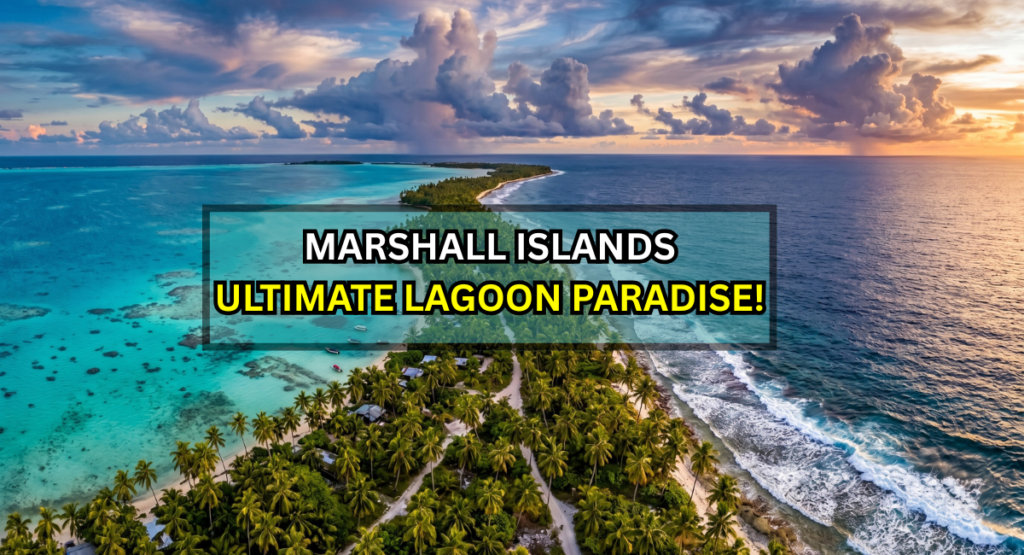
Marshall Islands Travel : I stepped off a tiny prop plane onto Majuro Atoll and felt the ocean close in from every direction. Standing on a strip of land barely 200 yards wide in some places, with the Pacific on my left and a lagoon the color of liquid turquoise on my right, I understood instantly why so few people make it here — and why everyone who does talks about it for the rest of their lives.
The Marshall Islands sits at the end of every “most remote places on Earth” list for a reason. Getting here takes effort. But what you find when you arrive is a Marshall Islands country unlike anything else on the planet — a place shaped by ancient Polynesian navigation, Cold War nuclear testing, and a people whose warmth will disarm even the most jaded traveler.
If you’ve been watching too much travel content lately and feel like every destination looks the same, the Marshall Islands map will show you an archipelago so spread out, so raw, and so genuinely off the radar that it recalibrates your entire sense of what travel can be.
 34 Expert Caribbean Cruise Tips Every Cruiser Should Know Before You Set Sail
 Eastern vs. Western Caribbean Cruise: Which One Is Actually Right for You?
 Best Anniversary Trips in the USA: 15 Unforgettable Destinations That’ll Make You Fall in Love All Over Again
 Top 10 Places to Visit in the World That Will Ruin Every Other Trip (In the Best Way)
Let’s get into it.
Quick Facts About the Marshall Islands
| Detail | Information |
|---|---|
| Country | Republic of the Marshall Islands |
| Capital | Majuro |
| Official Languages | Marshallese, English |
| Currency | US Dollar (USD) |
| Time Zone | MHT (UTC+12) |
| Visa Requirements | US citizens — no visa needed, no passport stamp required |
| Best Duration of Stay | 7–14 days |
| Population | Approximately 42,000 |
| Government | Presidential Republic |
Why the Marshall Islands Stopped Me In My Tracks
Marshall Islands Travel: I’ll be honest with you — I almost didn’t book this trip. The Marshall Islands doesn’t have the glossy marketing machine that Bali or Maldives runs. There’s no massive influencer scene here. The airport in Majuro is small enough that you can see the whole tarmac from the terminal window.
But a dive instructor friend of mine pulled up a photo of Bikini Atoll on his phone one afternoon and said quietly, “I’ve seen 40 countries underwater. Nothing compares to this.” That got my attention.
The Marshall Islands is a nation of 29 atolls and 5 isolated islands stretched across roughly 750,000 square miles of the central Pacific Ocean. Most of that is ocean. The total land area is barely 70 square miles — smaller than Washington D.C. — but the Marshall Islands map shows you a chain of atolls that spans an ocean corridor the size of Western Europe.
What makes this place hit different is the layering. You’re standing on coral atolls that Marshallese people have navigated for over 2,000 years using stick charts — handmade instruments that mapped wave patterns and island positions with startling accuracy. Beneath that history lies the wreckage of the Marshall Islands nuclear testing era, when the U.S. detonated 67 nuclear weapons on Bikini and Enewetak Atolls between 1946 and 1958. And beneath all of that, literally below the waterline, are some of the most spectacular marine ecosystems on Earth.
The Marshallese are a people shaped by extraordinary forces — ancient mastery of the sea, colonial rule, nuclear devastation, and now the existential threat of rising sea levels. Their story is not a comfortable one, but it is one of the most compelling you’ll encounter in any travel experience.
I knew within my first hour in Majuro that I’d be thinking about this place for years.
Have you ever arrived somewhere that felt nothing like what you imagined — in the best possible way? Drop your story in the comments.
Best Time to Visit the Marshall Islands
The Marshall Islands sits in the tropics, which means you’re dealing with two primary seasons. Planning your timing carefully makes a significant difference in both experience and cost.
34 Expert Caribbean Cruise Tips Every Cruiser Should Know Before You Set Sail
Eastern vs. Western Caribbean Cruise: Which One Is Actually Right for You?
Best Anniversary Trips in the USA: 15 Unforgettable Destinations That’ll Make You Fall in Love All Over Again
Top 10 Places to Visit in the World That Will Ruin Every Other Trip (In the Best Way)
| Month/Season | Weather | Crowd Level | Best For |
|---|---|---|---|
| Jan – Mar | Dry, 80–86°F, lower humidity | Low to Moderate | Diving, snorkeling, beach time — ideal conditions |
| Apr – May | Transitional, warm, occasional showers | Low | Best value flights, fewer tourists, still good diving |
| Jun – Aug | Wet season begins, 85–90°F, humid | Very Low | Budget travelers, lush green landscapes, lagoon kayaking |
| Sep – Nov | Peak wet season, heavy rains, possible typhoons | Very Low | Experienced travelers only; cheapest rates |
| Dec | Drying out, pleasant temperatures | Moderate | Shoulder season sweet spot — good weather, fewer crowds |
The Dry Season Sweet Spot (January through March)
If you’re planning your first trip to the Marshall Islands, January through March is your window. Trade winds keep things comfortable, visibility underwater can exceed 100 feet, and you’ll have the lagoons largely to yourself. The Marshall Islands population is small enough that “crowded” is a relative term here anyway — but this is when the islands feel most alive.
Why Some People Choose the Wet Season
Counterintuitively, June through November has its own appeal. Airfare drops noticeably, the atolls turn an almost supernatural shade of green, and the lagoons can be extraordinarily calm between rain systems. Just check weather forecasts carefully and have flexible dates.
Pro Tip: The dry season in the Marshall Islands runs counter to much of Southeast Asia’s peak travel window. If you’re a diver who’s tired of sharing reef systems with tour groups, February in Majuro might just be the answer.
Top Things To Do and See in the Marshall Islands
This is where the Marshall Islands earns its reputation. The activities here are not curated tourist packages. They’re raw, real experiences that put you directly in the water, on the reef, or inside a story that most travelers will never encounter.
1. Dive the Ghost Fleet of Bikini Atoll (UNESCO World Heritage Site)
This is the one. Bikini Atoll was ground zero for American nuclear testing in the post-WWII era, and what’s left on the seafloor is unlike anything else on the planet. Sunken U.S. and Japanese warships — including the USS Saratoga aircraft carrier and the Nagato, the Japanese flagship that was present at Pearl Harbor — lie between 50 and 180 feet down, draped in coral and surrounded by marine life.
The Marshall Islands nuclear testing irrevocably changed this atoll. The original Marshallese people of Bikini were relocated — promised they’d return, never able to. The islands remain largely off-limits for habitation due to residual radiation in the food chain. But diving here is permitted and carefully managed.
Visibility can reach 130 feet. The scale of these ships, sitting silent on the bottom of a Pacific lagoon, is something that photos genuinely cannot capture. Budget around $3,000–$5,000 for a liveaboard trip to Bikini, including flights from Majuro.
2. Explore Majuro’s Laura Beach
Laura Beach sits at the far western end of Majuro Atoll, about 30 miles from downtown. It’s a long, quiet stretch of white sand with none of the commercial development you’d find at a typical Pacific resort. The water is clear and calm, the shade is plentiful, and on a weekday afternoon you might have it entirely to yourself.
Rent a car or take the local bus (called a “jitney”) for around $1. The drive itself is worth it — you’ll cross the length of Majuro Atoll, seeing local neighborhoods, churches, and the extraordinary geography of an island barely wider than a tennis court in places.
3. Visit the Alele Museum and Public Library
The Alele Museum in Majuro is the best single place to understand Marshallese history, culture, and the traditional navigation that made these people legendary seafarers. The stick charts on display — called rebbelib and mattang — are physical maps of wave and swell patterns used to navigate the Pacific without instruments.
There’s also significant documentation of the nuclear testing era here, presented from a Marshallese people perspective. It’s sobering, important reading.
4. Snorkel the Majuro Lagoon
You don’t need to go to Bikini Atoll for extraordinary underwater experiences. The Majuro Lagoon is home to healthy coral formations, sea turtles, reef sharks, manta rays (seasonal), and a staggering diversity of fish. Several local operators run half-day snorkel trips for $30–$50 per person.
The outer reef drop-off near Eneko Island is particularly spectacular. The wall descends hundreds of feet and the current brings nutrient-rich water that attracts pelagic species. I spotted a hawksbill turtle within my first ten minutes in the water.
5. Day Trip to Eneko Island
Eneko Island is a tiny uninhabited coral island accessible by boat from Majuro in about 20 minutes. Locals rent it out for day trips — there are basic facilities, hammocks, and the kind of beach that makes you question every life decision that brought you to a desk job.
The snorkeling off Eneko is some of the best accessible from Majuro. Budget around $40–$60 for the boat and basic island facilities.
6. Kayak the Interior Lagoon
The Majuro Lagoon is one of the largest enclosed lagoons in the world. Paddling across it in a kayak at sunrise, with the water completely flat and the atolls appearing as thin green lines on the horizon, is the kind of experience that prints itself permanently in your memory.
Several guesthouses rent kayaks by the day. The water inside the lagoon is almost always calm, making it accessible even for casual paddlers.
7. Attend a Marshallese Church Service
This might sound like an odd travel recommendation, but hear me out. Christianity is deeply woven into Marshallese life and culture, and Sunday services at the main churches in Majuro are communal events featuring extraordinary choral singing. The Marshallese language sounds unlike anything in the Pacific region — it has a musicality that makes choral arrangements in it genuinely beautiful.
If you attend, dress modestly and arrive on time. The congregations are welcoming to respectful visitors.
8. Explore Kwajalein Atoll (With the Right Access)
Kwajalein Atoll hosts the Marshall Islands military base — specifically the Ronald Reagan Ballistic Missile Defense Test Site, operated by the U.S. Army. Access to the main island of Kwajalein is restricted to military and government personnel. However, the nearby island of Ebeye — called the “slum of the Pacific” by some, though the people there deserve better than that label — is accessible to visitors.
Ebeye houses the Marshallese workers who support the Kwajalein base and has a population density among the highest in the Pacific. It’s a difficult place to see but an important one for understanding the complex relationship between the Marshall Islands and the United States.
9. See the RMI Parliament (Nitijela)
The Marshall Islands parliament building in Majuro is a modest structure that belies the significant political decisions made within it. The country is a presidential republic — the Marshall Islands president is elected by the parliament rather than directly by the people. If you’re interested in Pacific politics and governance, observing the political landscape here firsthand is fascinating.
10. Fishing With Local Guides
Subsistence fishing is central to Marshallese culture. Several local operators offer fishing charters that range from trolling for yellowfin tuna in the open Pacific to bonefishing on the flats inside the lagoon. The bonefish here are plentiful and large, and the flats are essentially unfished compared to places like the Bahamas.
A full-day fishing charter runs around $200–$400 depending on the vessel and guide.
11. Wotje Atoll — Off the Beaten Path
If you’re willing to take a small interisland flight (Air Marshall Islands operates routes between atolls), Wotje Atoll offers WWII-era Japanese fortifications, exceptional snorkeling, and a village where you may be the only foreign visitor that week. Tourism infrastructure is essentially nonexistent, which means you’ll need to arrange accommodation through community guesthouses in advance.
This is raw Pacific travel. Pack everything you need, bring gifts for the community (school supplies are always welcome), and prepare for one of the most authentic cultural exchanges you’ll have anywhere.
12. Photography at Majuro Causeway at Golden Hour
The causeway connecting the islands of Majuro Atoll runs across the lagoon and offers unobstructed views of the sunset over the water in both directions. The light here at golden hour is spectacular — the flatness of the atolls means the sky dominates completely, and on clear evenings the colors are extraordinary.
Which of these experiences is calling your name most? I’d love to know in the comments — are you a diver, a cultural traveler, or somewhere in between?
Where To Stay, Eat, and Get Around the Marshall Islands
Where To Stay
Accommodation options in the Marshall Islands are limited but authentic. You won’t find international resort chains here.
Marshall Islands Resort (Majuro) — The largest and most comfortable hotel on the island. Ocean-view rooms run around $120–$180 per night. The location is good, the staff is helpful, and the sunrises from the oceanside rooms are genuinely beautiful.
Robert Reimers Hotel (Majuro) — A well-established mid-range option with a good restaurant and easy access to the main downtown area. Rates run $80–$130 per night.
Ajidrik Guesthouse (Majuro) — A budget-friendly locally-owned option. Basic but clean. Around $50–$70 per night.
Community Guesthouses (Outer Atolls) — If you venture to Wotje, Arno, or other outer atolls, community-run guesthouses are the only option. Typically $20–$40 per night, often including meals.
Where To Eat
Tide Table Restaurant (inside Robert Reimers Hotel) — The best restaurant in Majuro by most accounts. Fresh fish is the move. The grilled mahi-mahi and the local tuna poke are both excellent. Budget $15–$30 per person.
MIR Restaurant — Good mix of local and American food. Popular with both locals and the small expat community. Generous portions, reasonable prices.
Local Markets and Road-Side Stalls — Don’t overlook these. Freshly caught fish, breadfruit preparations, and coconut-based foods show up at local markets. This is where you taste what Marshallese people actually eat.
Traditional Marshallese food centers on fish, breadfruit, taro, coconut, and pandanus. Coconut crab is a delicacy — it’s legal to consume here but ask local guides about sustainability before ordering.
Getting Around
Within Majuro: The jitney bus system runs the length of the atoll for $1 or less. Car rentals are available through the hotels for $40–$70 per day. Taxis exist but are informal — most are just locals willing to give rides.
Between Atolls: Air Marshall Islands operates interisland flights on small prop aircraft. Tickets are inexpensive but schedules can be erratic. Book in advance and build extra days into your itinerary for weather delays.
Getting to Bikini Atoll: Liveaboard dive operations are the primary way to reach Bikini. Companies like Bikini Atoll Divers offer dedicated packages. There are no commercial flights to Bikini.
Pro Tips and Common Tourist Mistakes To Avoid
Bring US dollars in cash. ATMs in Majuro exist but can be unreliable. Credit card acceptance is limited outside the main hotels. The Marshall Islands currency is the US dollar, which makes transactions simple — but cash is essential, especially on outer atolls.
Don’t underestimate the sun. The equatorial Pacific sun is brutal. UV index regularly hits 11+ (the maximum on most scales). Reef-safe sunscreen, a rash guard, and a wide-brimmed hat are not optional.
Respect local culture around dress. Majuro is fairly relaxed, but outer atolls are more conservative. Modest dress — particularly for women covering shoulders and knees in villages — is appreciated and will be remembered positively.
Don’t bring drones without clearance. Drone regulations in the Marshall Islands are evolving, and flying near the Kwajalein military base area is absolutely prohibited. Confirm regulations before you travel.
Book accommodations and dive trips early. The total accommodation inventory on Majuro is small. During any kind of peak period, the better rooms fill quickly. The same applies to Bikini liveaboards, which often book out months in advance.
Medication and medical care: Medical facilities in the Marshall Islands are limited. Majuro has a hospital, but serious conditions require medical evacuation to Hawaii or Guam. Ensure your travel insurance covers emergency medical evacuation. The U.S. State Department travel advisory page at travel.state.gov maintains current health and safety guidance for the Marshall Islands.
Don’t visit Bikini without proper dive certification and experience. Bikini Atoll diving involves wreck penetration, significant depths, and currents. It’s not appropriate for beginners. Advanced open water certification and real deep diving experience are minimum requirements.
The internet is slow and expensive. Download your offline maps, entertainment, and travel documents before you arrive. Don’t plan on streaming anything.
Check CDC guidance before traveling. Hepatitis A vaccination is recommended, and depending on your travel timeline, other health precautions may apply. The CDC Travelers’ Health page covers the Marshall Islands specifically.
Budget Breakdown — What To Actually Expect To Spend
The Marshall Islands is not a budget destination in the traditional sense, primarily because of flight costs and limited competition in the accommodation market. But it’s also not extravagant once you’re there.
| Category | Budget Traveler | Mid-Range | Splurge |
|---|---|---|---|
| Flights (from US West Coast, round trip) | $800–$1,200 | $1,200–$1,800 | $1,800+ (business class) |
| Accommodation (per night) | $50–$70 | $80–$150 | $150–$200+ |
| Food (per day) | $20–$35 | $35–$60 | $60–$100+ |
| Activities (per day) | $20–$50 | $50–$150 | $150–$500+ (Bikini liveaboard) |
| Local Transport (per day) | $1–$5 | $10–$30 | $30–$70 |
| Total Per Day (excluding flights) | $91–$160 | $175–$390 | $390–$870 |
The Bikini Atoll Factor: If diving Bikini Atoll is on your list, budget separately. A full liveaboard package including flights from Majuro typically runs $3,000–$5,000 per person for a week. It’s expensive by any measure, but there is genuinely nowhere else on Earth you can dive like this.
Flight routing: Most travelers fly through Honolulu, Hawaii and then connect on United Airlines to Majuro. This is the primary routing. Occasionally you can route through Guam, but Honolulu is more common and reliable. Round-trip from the U.S. West Coast typically runs $900–$1,400 if booked 2–3 months in advance.
How To Plan Your Itinerary — Day-by-Day Suggestions
7-Day Marshall Islands Itinerary (Majuro Focus)
Day 1 — Arrival and Orientation Arrive in Majuro. Check into your hotel, recover from travel. Walk the Delap-Uliga-Djarrit area in the evening. Watch the sunset from the causeway. Eat at Tide Table — get the fresh fish.
Day 2 — Majuro Lagoon Deep Dive Morning snorkel trip on the outer reef. Afternoon at the Alele Museum. Evening, explore local markets and try breadfruit.
Day 3 — Laura Beach Day Take the jitney or rent a car and spend the full day at Laura Beach. Bring your own food and water. Snorkel, swim, and do absolutely nothing for several hours. This is mandatory.
Day 4 — Eneko Island Book a day trip to Eneko Island. Full day on the beach, snorkeling the surrounding reef. Back before dinner. This will likely be a highlight of the entire trip.
Day 5 — Kayaking the Lagoon Rent a kayak and explore the interior of Majuro Lagoon at your own pace. Sunrise on the water is worth the early alarm. Afternoon: visit the local church area, walk neighborhoods, talk to people.
Day 6 — Interisland Flight to Arno Atoll Arno Atoll is a 10-minute flight from Majuro and offers a genuinely traditional Marshallese community experience, excellent fishing flats, and minimal tourism infrastructure. Spend the night at a community guesthouse.
Day 7 — Return to Majuro and Departure Morning flight back to Majuro. Last swim in the lagoon. Souvenir shopping — look for locally made handicrafts including woven baskets and traditional crafts. Fly out.
14-Day Itinerary Upgrade
Add Wotje Atoll (days 8–10) for WWII history and extreme seclusion, and if budget allows, a 4-night Bikini Atoll liveaboard (days 10–14). This is the full Marshall Islands experience.
Frequently Asked Questions About the Marshall Islands
Are the Marshall Islands still a US territory?
No. The Marshall Islands is an independent nation — the Republic of the Marshall Islands — established in 1986 under the Compact of Free Association with the United States. The relationship gives Marshallese people the right to live and work in the U.S. without a visa, and the U.S. maintains defense responsibilities for the islands. But the RMI is fully sovereign with its own government, Marshall Islands president, and foreign policy.
Do they speak English in the Marshall Islands?
Yes. Both Marshallese language and English are official languages of the country. English is widely spoken in Majuro, particularly in government, business, and tourism contexts. On outer atolls, Marshallese is much more dominant. The traditional greeting in Marshallese is iakwe (pronounced roughly “yah-kway”), which loosely translates to “you are a rainbow” — easily one of the most beautiful greetings in any language.
Can US citizens live in the Marshall Islands?
Yes. Under the Compact of Free Association, American citizens can live, work, and reside in the Marshall Islands indefinitely without a visa. You cannot vote in RMI elections, but otherwise the arrangement is remarkably open. Many Americans working on Kwajalein military base and government contracts live here full-time. The average salary in the Marshall Islands for locals is significantly lower than U.S. standards, but expat compensation packages for contract work are competitive.
Do US citizens need a passport for the Marshall Islands?
Yes, you need a valid U.S. passport to enter the Marshall Islands. However, you do not need a visa, and U.S. citizens are not required to have their passport stamped upon entry under the Compact of Free Association. You can stay indefinitely. Keep your passport valid throughout your trip.
Why are the Marshall Islands famous?
The Marshall Islands is famous for several distinct reasons: the U.S. nuclear weapons testing conducted on Bikini and Enewetak Atolls (1946–1958), which included the largest U.S. nuclear detonation ever (Castle Bravo in 1954); the extraordinary traditional navigation culture of the Marshallese people; the Bikini Atoll UNESCO World Heritage dive site; and increasingly, as a front-line nation in the global conversation about rising sea levels and climate change — many of the atolls face genuine existential risk from ocean rise within this century.
Is the Marshall Islands a rich or poor country?
By global standards, the Marshall Islands is a developing nation with limited economic resources. The economy relies heavily on U.S. financial assistance through the Compact of Free Association, fishing license revenue, and the Marshall Islands ship registry — the country maintains one of the world’s largest open ship registries, which is why many commercial vessels sail under the Marshall Islands flag. GDP per capita is modest, and significant portions of the population live in relative poverty, particularly on outer atolls. Ebeye island, adjacent to Kwajalein, has some of the most severe overcrowding and poverty in the Pacific.
Is it safe to visit the Marshall Islands?
Generally yes. The Marshall Islands has a low violent crime rate. The primary safety concerns are environmental: strong currents around reef systems, equatorial sun exposure, limited medical infrastructure, and potential for typhoons during the wet season. The U.S. State Department does not have active “do not travel” advisories for the Marshall Islands. Standard travel precautions — securing valuables, being aware of your surroundings, and having comprehensive travel insurance — are all that’s needed for most visitors.
What are the birth defects associated with the Marshall Islands?
This is a deeply important and painful part of Marshallese history. The nuclear testing era caused elevated rates of radiation-related illnesses and birth defects in communities living near testing sites, particularly on Rongelap Atoll, which received significant fallout from the 1954 Castle Bravo test. Conditions documented in affected communities include thyroid cancer, leukemia, and a cluster of severe birth defects that Marshallese communities refer to as “jellyfish babies.” Compensation and healthcare support through the Nuclear Claims Tribunal has been ongoing but widely criticized as grossly insufficient relative to the documented harm.
Why are people leaving the Marshall Islands?
Several forces are driving outmigration. Climate change and rising sea levels pose a literal existential threat to low-lying atolls — many areas already experience regular flooding during king tides. Economic opportunity is significantly greater in the U.S. under the Compact of Free Association. Healthcare and educational resources are substantially better in Hawaii and the continental U.S. The Marshall Islands population has actually declined in recent years as communities relocate to Springdale, Arkansas — which has become the largest Marshallese community in the world outside the islands themselves — and to Hawaii.
What ethnicity are Marshall Islands people?
Marshallese people are Micronesian, a distinct Pacific ethnic group with roots that trace back approximately 2,000–3,000 years. Micronesian peoples are related to but distinct from Polynesian and Melanesian groups. The Marshallese have their own language (Marshallese language), cultural traditions, and genetic heritage that reflect millennia of island life and inter-atoll migration across the central Pacific. There is a small community of mixed-heritage residents and foreign nationals, but the population is predominantly ethnically Marshallese.
Is there a US military base in the Marshall Islands?
Yes. The Ronald Reagan Ballistic Missile Defense Test Site is located on Kwajalein Atoll and is operated by the U.S. Army. It’s one of the most important U.S. missile defense testing facilities in the Pacific. Access to the main Kwajalein island is restricted to authorized military and government personnel. The U.S. military presence on the islands is a significant part of the ongoing Compact of Free Association relationship between the U.S. and the RMI.
How do I get to the Marshall Islands from the USA?
The primary route is to fly to Honolulu, Hawaii and connect on United Airlines to Majuro International Airport (MAJ). United operates this route several times per week as part of its Micronesia service. Total travel time from the U.S. West Coast is typically 10–14 hours including the Honolulu connection. Book flights 2–3 months in advance for the best fares. There are no direct flights from the continental U.S. to Majuro.
Final Thoughts — Why the Marshall Islands Deserves a Spot On Your List
I’ve been to a lot of places. I’ve watched sunrises over Angkor Wat and eaten my weight in pasta in Italy and dived the Great Barrier Reef before the bleaching got bad. But standing on that Majuro causeway at 6 a.m., with the lagoon mirror-flat and the sky doing things I don’t have words for, I felt something I rarely feel anymore in travel — genuine surprise.
The Marshall Islands is not polished. It doesn’t have a world-class restaurant scene or luxury resorts or Instagram-optimized viewpoints with guardrails. What it has is a story unlike anywhere else on Earth, underwater experiences that will redefine your benchmarks, and a Marshallese people who carry extraordinary history with remarkable grace.
Go for the diving. Stay for the culture. Come back for everything you didn’t expect.
For official U.S. travel guidance including safety, visa, and health information for the Marshall Islands, visit travel.state.gov. For vaccination and health recommendations before traveling, consult the CDC Travelers’ Health page.
This guide was written for World Fusion Tours — your resource for independent travel intelligence on the Pacific and beyond.
Understanding the Marshall Islands Flag and National Identity
The Marshall Islands flag is one of the most meaningful pieces of symbolism in the Pacific. A deep blue field represents the Pacific Ocean. Two diagonal stripes — one orange, one white — cross the flag, symbolizing the equator and the two parallel chains of atolls (the Ratak, or “sunrise,” chain and the Ralik, or “sunset,” chain). A white star in the upper left has 24 points — one for each of the inhabited atolls and islands — with four longer points representing the urban centers of Majuro, Ebeye, Jaluit, and Wotje.
Understanding what the Marshall Islands flag represents gives you a richer lens for everything you’ll see on the ground. The people here are genuinely proud of their national identity, hard-won through decades of colonial rule and the struggle for independence.
The Ratak and Ralik Chains
The Marshall Islands map divides geographically into two parallel island chains running northwest to southeast. The Ratak Chain (sunrise side) includes Majuro, Mili, Arno, and Wotje. The Ralik Chain (sunset side) includes Kwajalein, Bikini, Jaluit, and Enewetak. Most tourism happens in the Ratak Chain simply because Majuro serves as the entry point.
The Marshall Islands Passport and Citizenship
Marshall Islands citizenship and the Marshall Islands passport deserve mention for travelers interested in global mobility topics. The RMI passport is not among the world’s most powerful — it provides visa-free or visa-on-arrival access to roughly 60–70 countries. However, Marshall Islands citizenship comes with the notable benefit of the Compact of Free Association, which allows Marshallese citizens to live and work in the United States without restriction.
Marshallese citizenship by investment programs have existed in various forms, making the Marshall Islands passport attractive to some international investors. If this is relevant to your travel planning, verify current program status with the RMI government directly, as these programs have changed over time.
People born in the Marshall Islands to at least one Marshallese parent are generally entitled to citizenship. People born in the Marshall Islands are not automatically U.S. citizens — this is a common misconception. The Compact gives Marshallese people the right to reside in the U.S., but U.S. citizenship requires separate qualification.
The Ship Registry — Why So Many Ships Sail Under the Marshall Islands Flag
You’ve almost certainly seen massive cargo ships and oil tankers listed as registered in the Marshall Islands without knowing why. The Marshall Islands operates the world’s second-largest open ship registry (behind Panama), with over 3,500 vessels registered under the Marshall Islands flag.
This is a major revenue source for the country — ship registration fees contribute significantly to government finances. The registry is administered largely through an office in Reston, Virginia, by a private management company under contract with the RMI government. Ships register here because the regulatory environment is stable, the fees are competitive, and the flag carries credibility in international maritime law.
So the next time you see a massive LNG tanker at a port with “Republic of the Marshall Islands” on its stern, you’ll know the connection. It’s one of the more interesting quirks of a tiny Pacific nation having an outsized impact on global commerce.
Practical Packing List for the Marshall Islands
Given the combination of intense sun, water activities, limited shopping, and significant travel time, packing smart matters more here than almost anywhere.
- Reef-safe sunscreen (SPF 50+ minimum) in large quantities — it’s hard to find locally and expensive
- Rash guard for snorkeling and sun protection
- Dry bags for electronics — you will be around water constantly
- Offline maps of Majuro downloaded to your phone (Google Maps works for this)
- Enough cash in USD to cover your entire trip — don’t rely on ATMs
- Any prescription medications for your entire stay plus extra — pharmacies are extremely limited
- Power adapter (the Marshall Islands uses standard US plugs and 110V — no adapter needed for Americans)
- Reef-safe insect repellent
- A headlamp — power outages are not uncommon on outer atolls
- Modest clothing for village visits (covered shoulders and knees)
What’s the one thing you always include in a packing list for remote Pacific travel that most guides forget to mention? Share it in the comments.