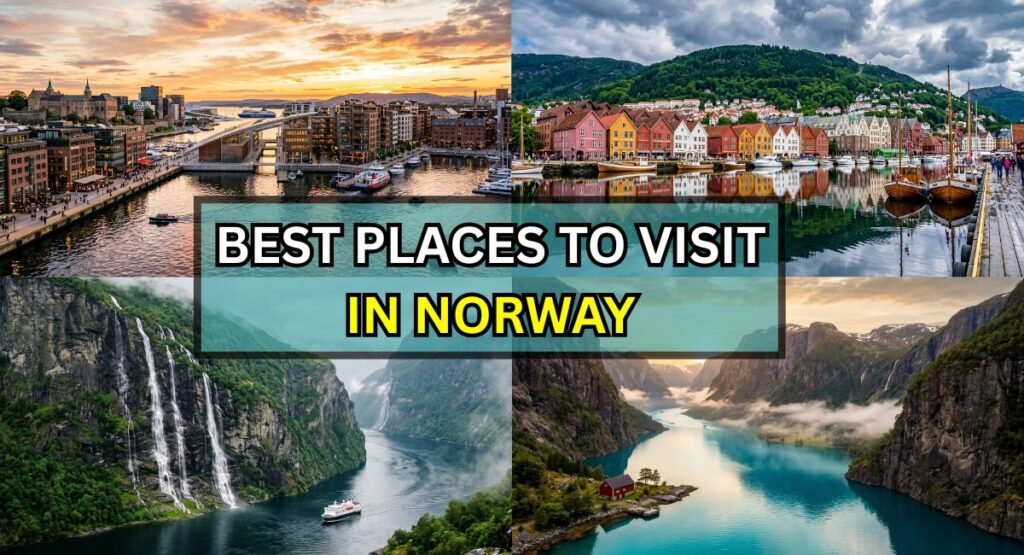
Best Places to Visit in Norway : Let me be straight with you — I almost didn’t go to Norway. I kept pushing it off, telling myself it was too cold, too expensive, too far. Then a buddy of mine showed me a photo he took from a hilltop in Ålesund at 2 a.m. when the sky was still glowing, and I booked my flights within the hour.
That trip rewired something in my brain. The best places to visit in Norway aren’t just beautiful in the Instagram sense — they’re the kind of places that make you feel genuinely small, humbled, and alive all at the same time. Fjords carved by glaciers, Viking cities buzzing with craft beer and contemporary art, tiny fishing villages perched on the edges of cliffs — Norway does not hold back.
✈️ Best Travel Deals
This guide is written for Americans planning their first or fifth Norwegian adventure. You’ll find real cost breakdowns in US dollars, honest opinions, and the kind of tips that only come from someone who’s actually been there — not someone who scraped a tourism board website and called it a day.
 34 Expert Caribbean Cruise Tips Every Cruiser Should Know Before You Set Sail
 Eastern vs. Western Caribbean Cruise: Which One Is Actually Right for You?
 Best Anniversary Trips in the USA: 15 Unforgettable Destinations That’ll Make You Fall in Love All Over Again
 Top 10 Places to Visit in the World That Will Ruin Every Other Trip (In the Best Way)
Let’s get into it.
Quick Facts — Norway at a Glance
| Detail | Info |
|---|---|
| Country | Kingdom of Norway |
| Capital | Oslo |
| Language | Norwegian (Bokmål & Nynorsk); English widely spoken |
| Currency | Norwegian Krone (NOK) — budget roughly $1 = 10–11 NOK |
| Time Zone | CET (UTC+1) / CEST (UTC+2 in summer) |
| Visa for US Citizens | No visa required — 90-day Schengen zone stay |
| Best Trip Duration | 10–14 days for a well-rounded experience |
| Power Plug | Type C/F (220V) — bring an adapter |
Why Norway Completely Stopped Me In My Tracks
I flew into Oslo on a Tuesday in early June. By Thursday evening I was sitting in a wooden rowboat on the Nærøyfjord, completely alone, listening to absolute silence except for water dripping off my oar. No Wi-Fi, no traffic noise, no other boats in sight — just these impossible cliffs rising 4,000 feet on either side of me.
That moment is why Norway is genuinely different from anywhere else on Earth.
It’s not just that Norway is beautiful, though it absolutely is. It’s that Norway forces you to slow down and confront the landscape on its own terms. The country has over 50,000 islands, more than 1,000 fjords, and a coastline that stretches nearly 64,000 miles when you count all the inlets. The scale is almost offensive.
For Americans specifically, Norway hits different because we’re used to having to drive for hours to find wilderness. Here, the wilderness is literally 15 minutes from the nearest train station. In Flåm, you step off one of the world’s most scenic railway journeys and immediately you’re surrounded by waterfalls. In Tromsø, you walk out of your hotel and the Northern Lights might be dancing above you.
Norway is also one of the safest countries in the world for American travelers. English is spoken everywhere — and I mean everywhere, even in tiny rural gas stations. The infrastructure is world-class. The people are friendly in a reserved, Viking-stoic kind of way that grows on you fast.
The one thing that surprises most Americans? The cost. Yes, Norway is expensive — we’ll talk real numbers — but it’s also shockingly manageable if you know what you’re doing.
🏠 Best Hotels & Accommodation
Best Time to Visit Norway: A Month-by-Month Breakdown
Timing your trip to Norway is everything. The country is dramatically different depending on when you show up, and both summer and winter have serious arguments in their favor.
34 Expert Caribbean Cruise Tips Every Cruiser Should Know Before You Set Sail
Eastern vs. Western Caribbean Cruise: Which One Is Actually Right for You?
Best Anniversary Trips in the USA: 15 Unforgettable Destinations That’ll Make You Fall in Love All Over Again
Top 10 Places to Visit in the World That Will Ruin Every Other Trip (In the Best Way)
| Month / Season | Weather | Crowd Level | Best For |
|---|---|---|---|
| January – February | Very cold (-5°C to 2°C / 23–36°F); heavy snow in the north | Low to Moderate | Northern Lights, dog sledding, skiing, fewer tourists |
| March – April | Cold but brightening (0°C to 8°C / 32–46°F) | Low | Budget travel, early spring landscapes, Sami culture festivals |
| May – June | Mild and pleasant (10°C to 18°C / 50–64°F) | Moderate (rising fast in June) | Midnight Sun begins, hiking season opens, wildflowers bloom |
| July – August | Warmest (15°C to 22°C / 59–72°F); some rain | Peak — very busy | Fjord cruises, coastal hiking, outdoor festivals, long daylight hours |
| September – October | Cooling down (6°C to 14°C / 43–57°F); fall color explosion | Low to Moderate | Autumn foliage, Northern Lights return north, cheaper prices |
| November – December | Cold and dark (−5°C to 4°C / 23–39°F) | Low except Christmas markets | Christmas markets in Bergen and Oslo, cozy hygge vibes, Northern Lights |
💡 Pro Tip: If chasing the Northern Lights is your main goal, aim for late September through February and base yourself north of the Arctic Circle — Tromsø is your best bet. If you want fjords and hiking with manageable prices, late May or early September are the sweet spots that most Americans miss entirely.
The “best time to visit Norway” honestly depends on which Norway you want to see. Summer Norway is green, golden-lit, and alive with energy. Winter Norway is raw, dark, and magical in a completely different way.
Top 15 Best Places to Visit in Norway — The List You Actually Need
These are not just the most Instagrammed spots. These are the places that deliver a genuine, layered Norwegian experience — from the world-famous to the ones I almost kept to myself.
1. Oslo — The Capital That Keeps Surprising You
Best for: First-timers, city culture, world-class museums, food scene
Most people treat Oslo as just a layover city. That’s a mistake. Oslo is one of the most livable, thoughtful, and genuinely cool capitals in Europe, and it rewards a few slow days more than almost any other Scandinavian city.
Start in the Aker Brygge waterfront district — it’s the beating heart of modern Oslo, where old harbor warehouses have been converted into restaurants, bars, and galleries. Walk west along the waterfront to the Tjuvholmen neighborhood and you’ll stumble into the Astrup Fearnley Museum of Modern Art, a stunning Renzo Piano-designed building that sits half over the water.
The Oslo Fjord itself is underrated. In summer, locals hop on public ferries (the same ferries covered by your regular transit pass) and head to the tiny islands of Hovedøya or Gressholmen for swimming and picnics. Doing this for $4 while Oslo’s skyline sits across the water feels like cheating the universe.
For museums, the Viking Ship Museum on the Bygdøy peninsula is obligatory — you’re standing within arm’s reach of real 9th-century Viking ships that were pulled from burial mounds. The Fram Museum, also on Bygdøy, tells the story of Norway’s polar expeditions in a way that genuinely grips you.
The Grünerløkka neighborhood is where Oslo’s creative class actually lives. Skip the tourist-heavy Karl Johans Gate and spend your evenings here — craft coffee shops, vintage stores, fantastic Korean and Vietnamese restaurants tucked between Norwegian bakeries.
Don’t miss: The Munch Museum (opened in 2021 in a striking new building), the Vigeland Sculpture Park (free, enormous, weird in the best way), and a morning at the Mathallen food hall for smoked salmon on rye with a proper Norwegian coffee.
2. Bergen — Gateway to the Fjords and the Most Charming City in Norway
Best for: Fjord access, UNESCO heritage, seafood, mountain views
If I had to pick one city in Norway to spend a long weekend, Bergen wins every time. The famous Bryggen Wharf — a row of colorful wooden hanseatic buildings running along the harbor — is one of the most photographed scenes in all of Scandinavia, and it genuinely looks better in person than in pictures.
Take the Fløibanen Funicular up Mount Fløyen. The ride takes seven minutes and deposits you at a viewpoint where the whole city, harbor, and surrounding fjords spread out below you. Come back at dusk and bring a jacket — the view at golden hour is ridiculous.
✈️ Best Travel Deals
Bergen’s Fisketorget fish market on the harbor isn’t just for tourists (well, mostly it is, but the food is still excellent). Grab a cup of fresh shrimp, squeeze some lemon on it, and eat it standing at the water’s edge. Cost is about $8–12 and it’s completely worth it.
The city gets heavy rainfall — Bergen averages 240 rainy days per year — so pack layers and a waterproof jacket regardless of when you visit. But honestly, Bergen in the rain has its own moody charm. The wooden buildings glisten, the harbor lights reflect on the water, and the bars and wine bars get wonderfully cozy.
🏠 Best Hotels & Accommodation
Bergen is also your jumping-off point for the Hardangerfjord and Sognefjord day trips, making it one of the most strategically valuable bases in Norway.
Don’t miss: The Bryggen Hanseatic Museum inside one of the original merchant houses, the KODE Art Museums (four connected museums covering Bergen’s art collection), and hiking the Seven Mountains trails that ring the city.
3. The Geirangerfjord — The Fjord That Makes People Cry
Best for: UNESCO World Heritage scenery, cruises, waterfall chasing
There’s a reason every Norway travel brochure eventually puts Geirangerfjord on the cover. This 9-mile-long fjord in western Norway is the country’s single most iconic landscape — and it earns every bit of that reputation.
The fjord’s walls rise nearly vertically from the water, some sections over 4,600 feet high. Tumbling down these walls are waterfalls with names like the Seven Sisters (seven cascading streams side by side), the Suitor (a single stream across the fjord that local legend says is trying to court the Sisters), and the Bridal Veil (a thin, ethereal fall that seems to disappear before it hits the water).
You can see the fjord from a cruise ship (many Atlantic itineraries call here), but the best way to experience it is to take the local Geiranger–Hellesylt ferry — a 65-minute ride that cuts directly through the fjord’s most dramatic section. Tickets run about $30–40 per person from the local ferry terminal, and you’re standing on an open deck with those waterfalls visible from both sides simultaneously.
The village of Geiranger itself is tiny — fewer than 250 permanent residents — but it’s extremely well set up for tourists with good restaurants and boat rentals. Hire a small motor boat for half a day and get close to the waterfalls. You can motor right into the spray of the Seven Sisters and get completely soaked. It’s one of those travel experiences you’ll be describing to people for years.
Getting there: Fly into Ålesund and drive the famous Ørnesvingen Eagle Road down into Geiranger — 11 hairpin turns with views that will have you pulling over every hundred yards.
4. The Nærøyfjord — The Narrow Wonder UNESCO Couldn’t Ignore
Best for: The most dramatic fjord scenery in Norway, kayaking, peaceful exploration
If Geirangerfjord is Norway’s showstopper, Nærøyfjord (pronounced “Neh-ROH-fjord”) is its quieter, more intimate sibling — and for many travelers who’ve done both, Nærøy actually wins.
At its narrowest point, the fjord is just 820 feet wide, with cliff walls rising 5,000 feet on either side. It’s a UNESCO World Heritage Site and the visual experience of floating through that narrow channel with waterfalls above you on both sides is something no photograph fully captures.
The base village of Flåm is your access point. Arrive by the Flåm Railway — more on that below — and rent a kayak or join a guided fjord kayak tour directly from the village harbor. Paddle into the Nærøyfjord and the motorboat traffic drops away within minutes.
For the full cinematic experience, take the morning Nærøyfjord fjord cruise from Flåm to Gudvangen (about 2 hours) and return by bus through the valley. The cruise costs roughly $35–50 per person and is worth every dollar.
Insider note: Stay overnight in Flåm and get up at 6 a.m. In midsummer, the morning mist sits low in the fjord valley and the light is absolutely otherworldly. Every tour group is still asleep. I had the entire Flåm harbor to myself for 45 minutes one morning and it was one of the best travel moments of my life.
5. The Flåm Railway (Flåmsbana) — The Train Ride That Changes How You Think About Train Rides
Best for: Scenic rail experience, accessing the fjord country, photography
I’ve ridden train routes on four continents and the Flåmsbana is the single most dramatic rail journey I have ever taken. Full stop.
This 12-mile narrow-gauge railway descends 2,844 feet from the mountain plateau at Myrdal down to the Flåm village at sea level — all through a valley carved so deep and steep that the train has to pass through 20 tunnels, including one where the track spirals inside a mountain to lose altitude. The whole journey takes 55 minutes and the train slows at key viewpoints so you can hang out the windows and shoot photos.
The standout moment is the stop at Kjosfossen Waterfall — the train literally stops here for a few minutes, doors open, and you walk out onto a platform with this roaring waterfall crashing down 755 feet right in front of you. In summer, there’s usually a performer in a red dress dancing on the rocks above — it’s part of a Norse legend performance that’s been running for years and is equal parts strange and wonderful.
✈️ Best Travel Deals
Round-trip tickets from Flåm to Myrdal run about $50–70 per adult. Book well in advance in July and August — this train sells out weeks ahead.
6. Tromsø — The Northern Lights Capital of the World
Best for: Northern Lights, Arctic experiences, winter adventure, dog sledding
Tromsø sits 217 miles above the Arctic Circle and it’s the single best best place to visit in Norway for Northern Lights chasing — particularly between late September and early March when the polar nights are long and dark.
The city of about 75,000 people has a surprisingly vibrant nightlife, excellent restaurants, a university that keeps the vibe young and energetic, and enough adventure tourism operators to fill your entire trip. Dog sledding, snowshoeing, whale watching in the fjords, reindeer feeding with Sami families — Tromsø has the highest concentration of Arctic experiences of any city in Norway.
For the Northern Lights specifically: don’t just stand outside your hotel and hope. Join a guided Northern Lights chase tour. The operators here have cloud-tracking experience and will drive you out of the city and away from light pollution to wherever the sky is clearest. Tours run $80–130 per person and the success rate with a good operator is dramatically higher than going it alone.
The Arctic Cathedral (Ishavskatedralen) is Tromsø’s most recognizable building — a striking angular white structure on the east side of the bridge. The midnight sun or Northern Lights reflecting off its facade is genuinely surreal.
In summer, Tromsø gives you the Midnight Sun experience — the sun doesn’t set for 67 consecutive days from late May to mid-July. It’s genuinely disorienting and wonderful in equal measure.
Don’t miss: The Polaria Arctic Experience Center, the rooftop bar at Scandic Ishavshotel, and a reindeer hot dog from a local food truck at 1 a.m. under the midnight sun.
7. Ålesund — The Art Nouveau City That Looks Like a Fantasy
Best for: Architecture lovers, coastal scenery, base for Geiranger, unique city character
Most people fly into Ålesund only because it’s the nearest airport to Geirangerfjord, and then they rush straight through. That is a genuine shame, because Ålesund might be the most visually distinctive city in Norway.
After a catastrophic fire in 1904 burned the entire city to the ground in a single night, Ålesund was rebuilt almost entirely in the Art Nouveau style — all at once, in the same period, by German and Norwegian architects. The result is a city of strikingly uniform, curving facades, ornate towers, and decorative stonework that feels like it was designed for a fairy tale.
Climb the 418 steps up Aksla Hill to the Fjellstua viewpoint. The panoramic view over the city’s islands, bridges, and surrounding fjords is the best city viewpoint I’ve encountered anywhere in Norway — better than Bergen’s Fløyen for sheer dramatic wow factor.
The JUGENDSTILSENTERET (Art Nouveau Center) inside a former pharmacy explains the city’s entire architectural story in a beautifully curated exhibition. Admission is about $15 and it’s genuinely worth an hour of your time.
The seafood restaurants around Brosundet Canal are excellent and slightly more affordable than Bergen or Oslo — grilled stockfish, salt cod, and freshly caught shellfish appear on most menus.
8. Lofoten Islands — Norway’s Most Dramatic Coastline
Best for: Dramatic landscapes, fishing village culture, photography, outdoor adventures
The Lofoten Islands are the destination that makes experienced Norway travelers say “I need to go back.” This archipelago north of the Arctic Circle features an almost absurd collision of jagged mountain peaks, deep blue waters, red and yellow rorbu fishing cabins, and tiny villages with more charm per square mile than almost anywhere in Scandinavia.
Reine is the most photographed spot in Lofoten — a small fishing village whose backdrop of mountains rising straight from the water has appeared on more camera rolls than perhaps any other Norwegian landscape. Svolvær is the main town and transport hub. Å (yes, the village is actually named just one letter) sits at the very southern tip and has a beautiful Norwegian Fishing Village Museum.
Hiking here is extraordinary: the Reinebringen trail above Reine involves scrambling up 1,600 feet of steep switchbacks to a ridge overlooking the entire archipelago. It’s hard and it’s worth every ounce of effort.
In winter, Lofoten gives you Northern Lights over those red fishing cabins — a combination that photographers specifically plan entire trips around. In summer, the light at 11 p.m. turns the mountains salmon-pink and the water a deep cobalt blue that looks fake in photos.
Getting there: Fly directly to Leknes or Svolvær from Oslo, or take the overnight Hurtigruten coastal ferry from Bergen — a journey that deserves its own bucket list entry.
9. Preikestolen (Pulpit Rock) — The Hike Every American Needs to Do
Best for: Iconic hiking, vertiginous views, bragging rights
Preikestolen, or Pulpit Rock, is a 1,982-foot flat-topped cliff jutting straight out from a mountainside above the Lysefjord. It’s one of the most dramatic natural platforms on earth, and the 3.7-mile round-trip hike to reach it is well within the abilities of a reasonably fit traveler.
The hike takes 4–5 hours round trip and gains about 1,148 feet of elevation. Trail sections include wooden boardwalk, rocky switchbacks, and some boulder scrambling near the top. You don’t need any special gear — just good hiking boots, layers, water, and snacks.
The payoff at the top is a completely flat rock shelf roughly the size of a basketball court, with nothing between you and a straight 1,982-foot drop into the fjord below. There are no barriers. I spent a solid hour at the top watching people slowly crawl on their stomachs to the edge while others dangled their feet off the side like it was nothing.
Start early. Like, 6–7 a.m. early. By 10 a.m. on summer weekends, the trail is heavily congested. The early morning light is also dramatically better for photos, and on clear mornings you’ll sometimes catch mist hanging in the fjord below, which makes the view even more spectacular.
The nearest base is Stavanger — a charming oil-and-gas city that’s very much worth a night or two.
10. Trolltunga — The Most Dramatic Cliff Hike in Norway
Best for: Serious hikers, once-in-a-lifetime photography, physical challenge
Trolltunga (Troll’s Tongue) is a horizontal rock ledge jutting out 2,300 feet above Lake Ringedalsvatnet — and the image of a single person standing at its tip against the Norwegian sky is one of the most reproduced travel photographs in the world.
This is not a casual hike. The round trip is 17–22 miles depending on your starting point and takes 10–14 hours of hard walking. Elevation gain exceeds 3,600 feet. You need proper hiking boots (not sneakers), warm layers, rain gear, at minimum 3 liters of water, and substantial food. The Norwegian Trekking Association mandates guided tours for inexperienced hikers from April 15 to June 1 when conditions are still wintry.
If you’re fit and prepared, doing Trolltunga is one of the best physical and visual experiences Norway offers. If you’re not, there’s no shame in doing Preikestolen instead — it’s still stunning and significantly safer.
The village of Odda at the bottom of the valley is your base. Some hikers stay in a mountain hut midway on the trail for a sunrise experience.
11. Hardangerfjord — Norway’s Orchard Fjord
Best for: Scenic driving, apple blossom season, fruit farm visits, quieter crowds
The Hardangerfjord is Norway’s second-largest fjord and arguably its most underrated one. While the crowds pile into Geiranger and Nærøy, the Hardangerfjord region stays refreshingly quieter — even in peak summer.
What makes Hardanger unique is the agriculture. The sheltered microclimate around the fjord produces massive orchards of apple, cherry, and plum trees. In May, when the blossoms are out, the fjord banks are carpeted in white and pink flowers with the snowcapped mountains behind them — it’s one of Norway’s most surprising and beautiful seasonal spectacles.
The village of Eidfjord is an excellent base, close to the thundering Vøringsfossen Waterfall (one of Norway’s most visited natural attractions) and the Hardangervidda National Park plateau. The village of Ulvik has a peaceful harbor and several excellent farm-stay experiences.
Drive the Hardanger Bridge — the longest suspension bridge in Norway — and pull over at every scenic lookout. The fjord looks different from every angle and every hour of the day.
12. Sognefjord — The King of All Norwegian Fjords
Best for: Scale, multiple villages, cycling, ultimate fjord experience
The Sognefjord is Norway’s longest fjord at 127 miles and its deepest at 4,291 feet — deeper than the North Sea itself at most points. If you want to understand the sheer scale of what glaciers did to this landscape over millions of years, the Sognefjord will recalibrate your entire sense of proportion.
The village of Balestrand on the northern shore is one of the most charming stops — a quiet community with apple orchards, a historic English-built church from 1897, and fjord views that go on forever. Fjærland at the end of one of the fjord’s arms sits beneath two glaciers (the Jostedalsbreen ice cap) and has an extraordinary collection of secondhand bookshops in abandoned old buildings.
The Norway in a Nutshell tour — a famous combination of train, bus, boat, and train that runs Oslo–Flåm–Bergen — passes through Sognefjord and is a genuinely excellent one-day or two-day experience for first-time visitors who want maximum scenery with minimum logistical stress.
13. Røros — The Best-Preserved Mining Town in Scandinavia
Best for: History, UNESCO heritage, off-the-beaten-path culture, winter charm
Røros is the Norway that most travelers completely skip — and that’s exactly why it made this list. This mountain town in central Norway is a UNESCO World Heritage Site and one of the best-preserved wooden mining towns in the entire world, with a history stretching back to the 1640s when copper was discovered nearby.
The entire town center looks almost unchanged from the 18th and 19th centuries. Dark wooden buildings with grass-covered roofs line cobblestone streets. The Røros Church (Bergstadens Ziir) dominates the skyline and can seat 1,600 people in a town that has fewer than 5,000 residents — a testament to the copper boom that once made this place wealthy.
Visit in winter when the town is blanketed in snow and temperatures drop to −20°C / −4°F. In February, the Rørosmartnan winter market has run continuously since 1854 — one of Europe’s oldest and most authentic winter fairs.
14. Svalbard — The Arctic Archipelago Where Polar Bears Outnumber People
Best for: Polar bears, Arctic wilderness, glacier walks, extreme adventure
If you want the wildest, most remote, most legitimately extreme travel experience Norway offers, Svalbard is it. This Arctic archipelago sits halfway between mainland Norway and the North Pole, and it has more polar bears (about 3,000) than permanent human residents (about 2,600).
Longyearbyen is the main settlement and the world’s northernmost town with a population over 1,000. You can fly here directly from Oslo in about 3 hours.
Guided glacier hikes, snowmobile expeditions across the Arctic tundra, polar bear safaris (by boat in summer, snowmobile in winter), and dog sledding across landscapes that look like a different planet — Svalbard offers experiences that simply don’t exist anywhere else on Earth.
Important: you cannot leave the main settlements without a licensed guide and cannot legally go outside town without carrying a rifle (polar bear protection) unless you’re on a guided tour. The operators here are excellent and this rule actually makes things safer and more interesting.
Midnight Sun in Svalbard runs from April 20 to August 22 — 4 solid months of 24-hour daylight.
15. Stavanger — Oil City with Surprising Soul
Best for: Base for Pulpit Rock, food scene, charming old town, cultural mix
Stavanger is Norway’s oil capital and that economic engine has produced a city with a surprisingly cosmopolitan food scene, a thriving arts community, and the best Gamle Stavanger (Old Stavanger) neighborhood outside of Bergen.
The old town is a collection of 173 white wooden houses from the early 19th century — immaculately maintained, free to walk through, and completely charming. The Norwegian Petroleum Museum is far more interesting than it sounds and gives excellent context for understanding modern Norway’s economy.
Stavanger’s restaurant scene punches above its weight. Sabi Omakase has held a Michelin star for years and is one of the best Japanese-Norwegian fusion experiences I’ve had outside of Japan. The city’s Øvre Holmegate (“Fargegaten” or Color Street) is one of Norway’s most photographed urban streets — every building painted a different bright color.
As the base for Pulpit Rock (Preikestolen) and the equally dramatic Kjeragbolten (a boulder wedged in a crevice 3,200 feet above the Lysefjord), Stavanger earns a minimum two-night stay.
Where to Stay, Eat, and Get Around Norway
Where to Stay
Norway’s accommodations cover a wide range, and your choices drastically affect your budget.
Budget options ($60–110/night):
- Hostels in Oslo (Anker Hostel, Generator Oslo), Bergen (Bergen Budget Hotel), and Tromsø
- DNA cabins (DNT huts) along hiking trails — basic but charming and well-maintained
Mid-range ($110–220/night):
- Fjordheim Guesthouse in Flåm, Brosundet Hotel in Ålesund, Thon Hotels across major cities
Splurge ($220–500+/night):
- The Juvet Landscape Hotel (literally floating above a river in a glass-walled cabin — featured in Ex Machina)
- Manshausen Island Resort in Nordland, Svart Hotel near Svartisen Glacier (once complete)
- Traditional rorbu (red fishermen’s cabin) rentals in Lofoten
Where to Eat
Norwegian food gets unfairly dismissed. Yes, it’s expensive — but the quality is exceptional.
Must-eat experiences:
- Smørbrød (open-faced sandwiches): smoked salmon, pickled herring, shrimp on dense rye bread. Grab these at any Deli de Luca for $8–12 per sandwich — this is real Norwegian fast food.
- Raspeballer (potato dumplings): heavy, starchy, and incredibly comforting — found at traditional restaurants across western Norway.
- Bacalao (salt cod stew): a Portuguese-influenced dish that became a staple in Bergen and Stavanger.
- Brunost (brown cheese): a sweet, caramel-flavored whey cheese that’s an acquired taste but completely addictive on fresh bread.
- Fårikål (lamb and cabbage stew): Norway’s unofficial national dish, especially good in autumn.
For affordable eating, hit grocery stores (Rema 1000, KIWI, Coop) and assemble your own meals from excellent local products. A full grocery-based lunch runs $8–12 per person versus $25–40 at a restaurant.
Getting Around
Norway’s transport system is excellent and well-integrated.
- Domestic flights: Scandinavian Airlines (SAS) and Norwegian Air connect Oslo with Bergen, Ålesund, Tromsø, and Bodø quickly. Book early for $60–120 one-way deals.
- Bergen Railway (Bergensbanen): Oslo to Bergen in about 7 hours — one of Europe’s great train journeys, passing the Hardangervidda plateau. Tickets from $40–80 booked in advance.
- Ferries and express boats: The Hurtigruten coastal steamship service connects Bergen with Kirkenes, stopping at 34 ports along the way. You can book single legs or the whole voyage.
- Car rental: Essential for fjord-country exploration. Rent from Oslo or Bergen, expect $60–100/day for a standard car. Gas is expensive — budget $80–100 per tank.
- Ruter transit app (Oslo) and Skyss (Bergen): Local transit apps that cover buses, trams, ferries, and metros within city regions.
Pro Tips and Common Tourist Mistakes to Avoid
Norway is nearly cashless. Cards are accepted everywhere including tiny farm stalls and hiking trail coffee huts. You’ll almost never need physical Norwegian Krone. Use a no-foreign-transaction-fee card (Charles Schwab, Wise, or Capital One Venture).
Norway’s “Freedom to Roam” law means you can legally camp almost anywhere in nature, as long as you’re 500 feet from the nearest inhabited house and leave no trace. This is an incredible freedom that most Americans don’t know exists — use it.
Norwegian mountains can turn dangerously cold and wet with almost no warning, even in July. Hypothermia has killed tourists who set out in jeans and sneakers on what looked like a nice day. Always carry a rain jacket, extra layer, water, and snacks on any hike over 2 hours.
Norway’s fjord region has limited accommodation and ferry capacity, and July in particular sells out weeks ahead. Book trains, ferries, and accommodations at least 6–8 weeks in advance for summer travel. The Flåm Railway specifically needs to be booked as early as possible.
Both cities offer tourist passes covering public transit, major museum entry, and some discounts. The Oslo Pass (1-day, 2-day, 3-day options starting at $55) is worth it if you’re hitting 3+ paid museums in a day. The Bergen Card (1 or 2 days, from $42) covers the Fløibanen funicular and many museums.
Even in Tromsø, you won’t see Northern Lights every night. Cloud cover is the main enemy. Book a tour with a reputable operator who has vehicles and will drive you to clear skies — and then book 3–4 nights minimum to give yourself enough attempts to succeed.
- Never book only one night in Lofoten — it’s too far to go for less than 3 nights.
- Never underestimate the time required for fjord drives — what looks like 60 miles on a map might take 3 hours on mountain roads with tunnels and ferries.
- The Norway Tourist Board recommends checking official travel advisories at travel.state.gov before any international trip, including health requirements and current entry rules.
Budget Breakdown: What a 10-Day Norway Trip Actually Costs Americans
Norway has a reputation for being brutally expensive, and it can be — if you don’t plan. But here’s an honest, itemized breakdown of what a 10-day trip actually costs for an American traveler in 2025.
| Category | Budget Traveler | Mid-Range | Comfortable Splurge |
|---|---|---|---|
| Round-trip flights (from NYC) | $700–900 | $900–1,300 | $1,500–2,500+ |
| Accommodation (per night) | $60–90 | $110–180 | $220–450 |
| Food (per day) | $30–45 (grocery + one café meal) | $60–90 (mix of restaurants) | $100–160 (restaurants daily) |
| Internal transport (10 days) | $150–250 (trains + ferries) | $300–500 | $500–900 (rental car + ferries) |
| Activities & tours | $100–200 | $250–400 | $500–1,000+ |
| Total Estimated (10 days) | ~$2,200–3,000 | ~$3,500–5,000 | ~$6,000–11,000+ |
The honest reality: most Americans do Norway on a mid-range budget of $3,500–5,000 total for 10 days including flights, and they have an excellent experience. The biggest money-savers are: cooking your own breakfast and lunch from supermarkets, using trains instead of domestic flights where time allows, and traveling in May or September instead of July.
Norway’s public tap water is some of the cleanest in the world — never pay for bottled water. Carry a reusable bottle and refill from any tap, stream, or waterfall you encounter.
How to Plan Your Norway Itinerary: Day-by-Day Sample Schedules
Option A: Classic 10-Day Norway for First-Timers
Days 1–2: Oslo Arrive, recover from jet lag, explore Bygdøy museums (Viking Ships, Fram Museum), afternoon in Grünerløkka, evening at Aker Brygge waterfront.
Day 3: Oslo → Bergen (Bergen Railway) Take the scenic 7-hour Bergen Railway. Arrive Bergen late afternoon, check in, evening walk along Bryggen Wharf.
Days 4–5: Bergen + Day Trip to Hardangerfjord Day 4: Fløibanen funicular, Bryggen, Fisketorget, KODE museums. Day 5: Day trip by car or bus/ferry to Hardangerfjord.
Day 6: Bergen → Voss → Myrdal → Flåm (Norway in a Nutshell) Take train to Myrdal, ride the Flåmsbana down to Flåm, afternoon fjord cruise on Nærøyfjord, overnight in Flåm.
Day 7: Flåm → Geiranger (via Ålesund) Drive or ferry/bus connection through stunning mountain scenery to Ålesund, explore the Art Nouveau city, continue to Geiranger.
Day 8: Geirangerfjord Morning Eagle Road drive, full-day fjord cruise or kayak, explore Geiranger village.
Day 9: Geiranger → Stavanger (fly) Fly from Ålesund to Stavanger. Afternoon in Gamle Stavanger old town, evening on Øvre Holmegate.
Day 10: Preikestolen Hike → Fly Home Early morning hike to Pulpit Rock (start by 6:30 a.m.), return to Stavanger, late afternoon flight back to Oslo for connection home.
Option B: Northern Lights & Arctic Norway (10 Days, Winter)
Days 1–2: Oslo — Winter walking tour, National Gallery, Vigeland Park in snow. Days 3–4: Tromsø — Arctic Cathedral, Northern Lights chase tours each night, whale watching in nearby fjords. Days 5–7: Lofoten Islands — Fly to Leknes, explore Reine, Å, Nusfjord, Northern Lights over the rorbu cabins. Days 8–9: Røros — Mountain train from Oslo (or fly), explore the UNESCO mining town, Rørosmartnan winter market (February). Day 10: Oslo departure.
FAQ: Your Real Norway Questions, Answered
What is the prettiest place in Norway?
Almost every traveler who has been to Lofoten Islands points there — specifically the village of Reine with its mountain backdrop. For fjord scenery, the Nærøyfjord and Geirangerfjord compete for the top spot, but the Lofoten Islands offer a variety of beauty (coast, mountains, fishing culture) that makes it the all-around winner for most visitors.
Is Norway very expensive for Americans?
Yes — Norway is one of the most expensive countries in the world. A sit-down restaurant dinner runs $30–60 per person without alcohol. A beer in a bar costs $10–15. However, if you grocery shop for most meals, use trains instead of renting a car where possible, and travel in shoulder season, a well-planned 10-day trip can be done for $3,500–4,500 total including flights from the US East Coast.
Where to visit in Norway for the first time?
Start with Oslo for 2 nights, Bergen for 2 nights, and then the “Norway in a Nutshell” route (Flåm Railway + Nærøyfjord cruise) for 1–2 nights. This classic loop covers the best of the fjord country efficiently and gives a genuine taste of both urban Norway and its natural landscape without overwhelming logistics.
Which is nicer, Oslo or Bergen?
Completely different experiences. Oslo is a world-class modern capital with outstanding museums, a serious food scene, and urban energy. Bergen is more intimate, surrounded by nature, and the most convenient base for fjord exploration. For first-timers, Bergen wins on pure charm and scenic impact. But Oslo surprises almost everyone who gives it more than a day.
What time of year is best to visit Norway?
For hiking, fjords, and the Midnight Sun experience: late May through mid-September. For Northern Lights: late September through February, ideally based in Tromsø or Lofoten. The absolute best value windows are late May (before peak crowds) and September (after peak crowds, fall colors beginning, Northern Lights returning to the north).
What does a US citizen need to visit Norway?
A valid US passport (valid for at least 3 months beyond your planned departure from Norway). No visa is required for stays up to 90 days within the Schengen Area. Check current health and entry requirements on the US State Department Norway Travel Advisory page before your trip.
Is the train ride from Oslo to Bergen worth it?
Absolutely, without question. The Bergen Railway (Bergensbanen) is one of Europe’s most scenic rail journeys — 7 hours of mountain plateau, snow-covered passes, and dramatic valley descents. Book a window seat on the right side traveling west (Bergen-bound) for the best views. Tickets from roughly $40–80 booked in advance through Vy.no.
How much does a 7-day trip to Norway cost for an American?
Budget roughly $2,500–4,000 total for a 7-day trip including round-trip flights from the US East Coast, accommodation, food, and activities. The biggest variable is flights — booking 3–4 months in advance and flying into Oslo (the cheapest gateway) saves significantly. Traveling in May or September instead of July cuts accommodation and activity costs by 15–25%.
What is the cheapest month to visit Norway?
January through March offers the lowest prices across the board — hotels, flights, and activities all drop significantly outside ski resort areas. March is particularly good value: prices are low, daylight is returning, and if you head north, the Northern Lights are still active. For summer travel, May and early September are the budget sweet spots.
How do you say “hi” in Norway?
“Hei” (pronounced like the English “hey”) is the standard casual greeting in Norwegian. “God dag” (good day) is more formal. “Takk” means thank you. Norwegians appreciate any attempt to speak their language, but the vast majority speak fluent or near-fluent English, so you’ll have no trouble communicating anywhere in the country.
Can I wear jeans in Norway?
Absolutely — Norwegians wear jeans constantly. There is no dress code pressure in Norway outside of upscale restaurants (which are business casual at most). For hiking and outdoor activities, cotton jeans are actually not recommended because they stay wet and cold when it rains — bring quick-dry hiking pants instead. For city sightseeing, wear whatever you’re comfortable in.
Is Sweden or Norway better to visit?
Different experiences entirely. Norway wins on natural scenery — fjords, Northern Lights, Arctic landscapes, dramatic hiking. Sweden wins on urban culture, Stockholm’s old town (Gamla Stan), archipelago islands, and slightly lower prices. If natural landscapes are your priority, Norway. If you want a richer city-culture mix with easier budgeting, Sweden. Many travelers wisely do both on the same trip.
Final Thoughts: Book the Trip
Norway doesn’t need much of a sales pitch from me. The country sells itself the moment you stand at the edge of a fjord or watch the Northern Lights pulse green and violet across a winter sky above Tromsø.
What I want to leave you with is this: Norway is more accessible than Americans tend to assume. The language barrier is essentially nonexistent. The infrastructure is world-class. The safety record is excellent. The expense is real but manageable with planning.
The best places to visit in Norway cover an extraordinary range — from the art nouveau streets of Ålesund to the Arctic wilderness of Svalbard, from the hushed narrowness of the Nærøyfjord to the iconic ledge of Preikestolen. You won’t run out of Norway in one trip. Most people who go once come back within three years.
For current health guidance and vaccination recommendations relevant to international travel to Norway, check the CDC Travelers’ Health page for Norway before your trip.
Go book your flights. You’ll thank yourself later.
This guide was produced by World Fusion Tours — your trusted resource for real travel experiences, honest destination guides, and American-focused trip planning across the globe.